Busconcept Other models
1 model in this series
Busconcept MB Sprinter – a special-purpose vehicle on a Mercedes Sprinter base with a 2.0-litre four-cylinder diesel, 140 kW, 5,500 kg gross weight and around 1,575 kg payload
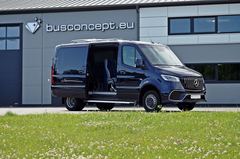
Busconcept builds special-purpose vehicles based on the Mercedes-Benz Sprinter, here with a gross vehicle weight of 5,500 kg. The Sprinter is Mercedes-Benz's light van and chassis platform, which body builders use as a base for minibuses, motorhomes and special bodies. At 5,500 kg, this chassis falls into EU class N2.
Read on 3 more paragraphs
The four-cylinder diesel engine has a displacement of 1,950 cm³ and produces 140 kW. At a kerb weight of 3,925 kg, payload comes to around 1,575 kg. Overall length is 7,367 mm and width 2,020 mm. The combination of comparatively small displacement with a high output of 140 kW – over 71 kW per litre – shows the high degree of turbocharging in modern van diesel engines.
A vehicle in this weight class requires an EU category C1 driving licence. If such a chassis is built as a minibus with more than eight passenger seats, a category D1 licence is additionally required. Chassis of this size serve, depending on the body, as minibuses for passenger transport, as a base for motorhomes, or as box vans for commercial goods transport.
For a used Sprinter chassis of this type, check the condition of the turbocharger and exhaust after-treatment on the four-cylinder diesel, wear on the clutch and gearbox, corrosion on the chassis and tow hitch, and, depending on the body, the condition of the interior fittings, seats or motorhome systems. For such a young vehicle, the completeness of the warranty and service records from the body builder also matters.
Sources: SpecCodex-Register: Kennwerte des Modells Busconcept MB Sprinter
Models
Truck in 3D section
Turn the model, look inside and click an assembly — each one is explained.
