SAME Lamborghini Hürlimann Other models
1 model in this series
Lamborghini/Hürlimann GALAXY 170 DT: four-wheel-drive six-cylinder tractor rated at 121.4 kW and 6,180 kg weight outside the named ranges
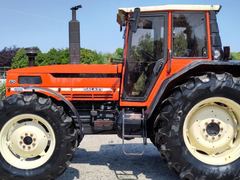
Lamborghini Trattori and Hürlimann were independent tractor brands that, alongside SAME and Deutz-Fahr, became part of the same corporate group and continued under their own names. The GALAXY 170 DT sits on the collective page for models outside the separately named ranges, yet it forms its own heavy power segment within the programme.
Read on 3 more paragraphs
The GALAXY 170 DT is powered by an air-and-oil-cooled six-cylinder engine of 6,234 cc, producing 121.4 kW (165 hp) at 2,200 rpm with 620 Nm of torque. The DT suffix stands for doppia trazione, meaning four-wheel drive. At a weight of 6,180 kg, a wheelbase of 2,856 mm and a width of 2,150 mm, the tractor reaches a design top speed of 30 km/h. The engine runs on diesel.
A six-cylinder of more than six litres with four-wheel drive marks a heavy field tractor for tillage and drawbar work demanding high pulling force. Air-and-oil cooling dispenses with a water-fed cooling circuit and was common on diesel engines of this origin. The power take-off runs at the standard 540 or 1,000 rpm, and the three-point hitch follows ISO 730, typically carrying category 2 implements at this weight.
Buying a used six-cylinder this old and this heavy, the air-and-oil cooling with its fan and the engagement of the front axle for four-wheel drive deserve particular attention. Also worth checking at inspection are the injection system, hydraulic tightness and the condition of the PTO bearings.
Sources: SpecCodex-Register: Kennwerte des Modells GALAXY 170 DT
Models
Tractor in 3D section
Turn the model, look inside and click an assembly — each one is explained.
