Landini Globus-Baureihe
1 model in this series
Landini Globus series – the 70 DT: a four-cylinder diesel producing 48.5 kW with 186 Nm of torque and four-wheel drive for mid-weight field work of the 1990s
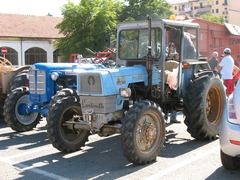
Landini is an Italian tractor manufacturer based in Fabbrico in the province of Reggio Emilia, now part of the Argo Tractors group. On the 70 DT of the Globus series, the letters "DT" stand, as with other Italian manufacturers, for "doppia trazione", meaning four-wheel drive.
Read on 3 more paragraphs
The 70 DT is powered by a water-cooled four-cylinder diesel engine of 2,955 cm3 displacement, producing 48.5 kW, or 66 hp, at 2,600 rpm, with 186 Nm of torque. At an unladen weight of 2,520 kg the machine reaches 30 km/h. A wheelbase of 2,006 mm, a width of 1,770 mm and a height of 2,390 mm on a 3,605 mm length describe a compact build.
A four-cylinder engine runs more smoothly than a three-cylinder of the same class and delivers torque more evenly across the rev range, which is noticeable during PTO work with fluctuating loads. The PTO shaft runs at the standard 540 or 1,000 rpm, and the three-point linkage under ISO 730 accepts implements of the lower categories. At a top speed of 30 km/h the machine stays well below the 60 km/h ceiling of the German T licence class.
When buying a used four-wheel-drive tractor of this age, it is worth checking the clutch disc and gearbox, which wear faster under heavy PTO use, as well as the front axle bearings and the drive shafts to the front axle. Leaking crankshaft seals, corrosion on the radiator, and the operation of the hydraulic connections all belong on the checklist, as does the availability of spare parts for a series that has not been produced for years.
Sources: SpecCodex-Register: Kennwerte des Modells 70 DT
Models
Tractor in 3D section
Turn the model, look inside and click an assembly — each one is explained.