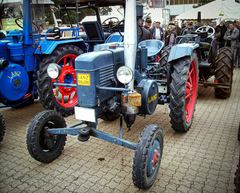
Heinrich Lanz HE series
2 models in this series
Heinrich Lanz HE series – final Mannheim Bulldog years D 4506 and D 5506: single-cylinder hot-bulb engine, 2,807 cm³, multi-fuel, 8.8 to 11.7 kW

Heinrich Lanz built the Bulldog in Mannheim from 1921, Germany's first series-produced hot-bulb tractor – a horizontal single-cylinder two-stroke engine that, thanks to hot-bulb ignition, could burn almost any combustible oil. The HE series with the D 4506 and D 5506 models belongs to the last Bulldog production years: in 1956 John Deere took over the Mannheim plant but kept Bulldog production running under the D series until 1960, before its own John Deere models replaced it. Both models share the proven single cylinder with 2,807 cm³ displacement and the typical multi-fuel capability; the register lists gas oil, brown-coal tar oil, diesel oil, paraffin oil and petrol as possible fuels.
Read on 3 more paragraphs
The register lists 2 versions here with 8.8 to 11.7 kW from the single cylinder at 900 to 950 revolutions per minute. Kerb weights range from 1,130 to 1,180 kg, lengths from 2,745 to 2,750 mm, widths from 1,685 to 1,735 mm and heights from 1,850 to 1,880 mm.
The Lanz Bulldog shaped the mechanisation of German farming for decades and stood for ruggedness and simple maintenance without delicate injection technology. The late D models such as the D 4506 and D 5506 mark the end of this design, shortly before hot-bulb engines were superseded by modern post-war injection diesels.
When buying used, the condition of the hot bulb and cylinder liner matters most, since the two-stroke engine depends on precise preheating; leaking piston rings and worn valves show up as poor cold-starting. Coolant circuit, fuel lines for multi-fuel operation and the simple mechanical brake should be checked; spare parts for Bulldog engines are supplied by specialist vintage workshops and Lanz clubs.
Sources: SpecCodex register, model data: Heinrich Lanz HE-Reihe, Lanz Bulldog (Wikipedia)
Models
Tractor in 3D section
Turn the model, look inside and click an assembly — each one is explained.