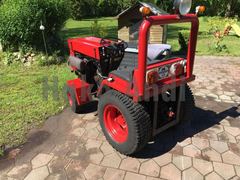
Hako Hakotrac
2 models in this series
Hako Hakotrac: compact multi-purpose implement carriers from Bad Oldesloe, Hakotrac 1200 and T6, 4.4 to 7.6 kW / 6 to 10 hp, single-cylinder petrol engines

The Hakotrac series comes from Hako of Bad Oldesloe in Schleswig-Holstein, a maker specialising in municipal cleaning and grounds-care equipment as well as compact multi-purpose implement carriers. Hako was founded in 1948 and gradually expanded its range from hand-guided small equipment to ride-on implement carriers such as the Hakotrac series. The Hakotrac 1200 and T6 are small implement carriers powered by single-cylinder petrol engines, built for grounds care, transport and small-scale winter service.
Read on 3 more paragraphs
The register lists 2 versions here with 4.4 to 7.6 kW (6 to 10 hp) from single-cylinder engines of 148 to 487 cm³, an unladen weight of around 190 kg, a length of 1,750 mm, a width of 550 mm and a height to the steering wheel of 1,090 mm at a rated speed of 4,500 rpm.
As compact implement carriers, Hakotrac models are aimed at municipal operators, nurseries and smaller farms that can be equipped flexibly for mowing, sweeping and transport work using interchangeable attachments. Quick tool changes without additional equipment are among the series' key design features.
When buying one of these small petrol engines, attention should go to the condition of the engine and carburettor, the function of the quick-change implement coupling, the tightness of the hydraulics, and frame rust, as well as the integrity of the frame and seat mount, which take heavy strain from frequent tool changes on these small implement carriers; spare parts are available through Hako's dealer network.
Sources: SpecCodex register, model data: Hako Hakotrac, Hako (manufacturer)
Models
Tractor in 3D section
Turn the model, look inside and click an assembly — each one is explained.