Eicher Schmalspur 3700
1 model in this series
Eicher 365 S (narrow-track 3700): air-cooled four-cylinder narrow-track tractor from Bavaria with 65 hp, a weight of 1,780 kg and a width of 1,400 mm, built from 1976 to 1979
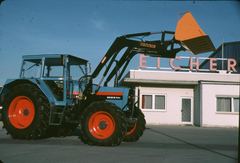
The 365 S belongs to the narrow-track 3700 range of the Bavarian manufacturer Eicher and was built between 1976 and 1979. Like the smaller narrow-track models, the range was designed for work between closely planted tree or vine rows, but with four cylinders instead of two and considerably more power it turned out noticeably larger than the slimmer earlier models in this product family.
Read on 3 more paragraphs
The air-cooled four-cylinder diesel engine of 3,927cc produces 65 hp (48 kW) at 2,150 rpm. At 1,780 kg, 3,400 mm long, 1,200 mm high and 1,400 mm wide, the 365 S is markedly stronger and longer than a simple two-cylinder narrow-track tractor; the wheelbase is 2,150 mm and the top speed 25 km/h.
With four cylinders and 65 hp, the 365 S covers the upper power class within the narrow-track family, making it suited to row crops with a wider row spacing, such as larger orchards or hop gardens, where the smaller two-cylinder models reach the limit of their pulling power. The air-cooled four-cylinder engine offers the same frost resistance as the range's smaller engines.
When buying one of these tractors second-hand, the condition of the air-cooled cylinder heads and the cooling-fan belts matters, since a failure of the cooling-air ducting on the four-cylinder engine leads to overheating faster than on the smaller engines. Also worth checking are the clutch and gearbox for wear from working with heavy mounted implements, and the narrow axle construction for play and corrosion caused by plant-protection chemicals.
Sources: SpecCodex-Register: Kennwerte des Modells 365 S
Models
Tractor in 3D section
Turn the model, look inside and click an assembly — each one is explained.