Eicher Puma (ES)
1 model in this series
Eicher Puma II (ES 400): air-cooled three-cylinder farm tractor from Bavaria with a 2,944cc engine, 38 hp and a weight of 1,560 kg, built from 1963 to 1970
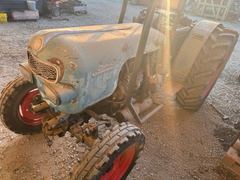
Eicher was a Bavarian tractor manufacturer based in Forstern near Amerang that built its own farm tractors with air-cooled diesel engines from the 1930s into the 1970s – a technology otherwise mainly associated in German tractor building with Deutz and Hatz. The Puma II (ES 400) belongs to the Puma range and was built between 1963 and 1970, a period when West German farms increasingly turned to compact but sufficiently powerful tractors for medium-sized holdings.
Read on 3 more paragraphs
The three-cylinder diesel engine displaces 2,944cc and produces 38 hp at 2,000 rpm. At 1,560 kg, 2,920 mm long, 1,220 mm high and 1,065 mm wide, the Puma II counts among the compact standard tractors of its era; a 1,995 mm wheelbase gives it a stable yet manoeuvrable stance. Its design top speed is 19.3 km/h.
Air-cooled diesel engines dispense with cooling water, a radiator and a water pump, which makes them frost-resistant and low-maintenance, though they run noisier than liquid-cooled units. A three-cylinder engine of this size was built for classic field work: ploughing, harrowing and driving mounted implements through the power take-off, not for the heavy drawbar work expected of tractors today.
When buying one of these tractors second-hand, the condition of the cylinder heads and cooling fins matters most, as cracks are not uncommon on air-cooled diesels of this age. Also worth checking are the clutch, the power take-off drive and the tightness of the injection pump; parts for Eicher engines today come mainly from specialist vintage-vehicle dealers rather than a regular supply network.
Sources: SpecCodex-Register: Kennwerte des Modells Puma II (ES 400)
Models
Tractor in 3D section
Turn the model, look inside and click an assembly — each one is explained.
