Belarus MTЗ
1 model in this series
MTZ-1: the tractor of the Minsk Tractor Works from 1954 to 1957, four-cylinder with 37 hp at 1,400 rpm, 3,150 kg unladen weight
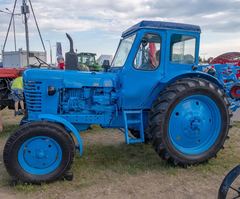
The MTZ-1 was built from 1954 to 1957 at the Minsk Tractor Works, which has built tractors in the Belarusian capital Minsk since 1946 and was, through the decades of the Soviet Union, one of the most important tractor makers for agriculture across the entire USSR.
Read on 3 more paragraphs
The four-cylinder diesel engine of 4,080 cm³ displacement produces 37 hp at 1,400 rpm – a low rated speed typical of diesel engines of the 1950s, and a modest output for a four-cylinder of this displacement, placing the MTZ-1 in the class of light to mid-size field tractors of its time. With an unladen weight of 3,150 kg, a length of 3,708 mm, a width of 1,884 mm, a height of 2,423 mm and a wheelbase of 2,410 mm, it is built correspondingly compact.
Tractors of this period ran at the standardised PTO speed of 540 rpm, which has survived in farm machinery to this day; three-point hydraulics to the later-introduced ISO 730 standard were not yet universal in the mid-1950s, and many implements worked from draft or trailer hitches instead. The MTZ-1 thus belongs to the early phase of tractor building after the Second World War.
Surviving examples are collector's vehicles today; when buying one, the condition of the engine and cooling system, the originality of sheet-metal parts, the driver's station and attachments, and the availability of spare parts, which for a tractor of this age can usually only be obtained through custom remanufacture or from other collectors, all matter. Rust on the frame and axles often decides the scope of restoration work needed.
Sources: SpecCodex-Register: Kennwerte des Modells MTZ-1
Models
Tractor in 3D section
Turn the model, look inside and click an assembly — each one is explained.