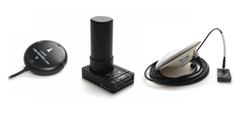
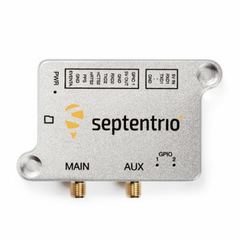
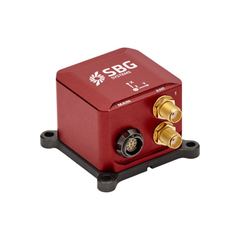
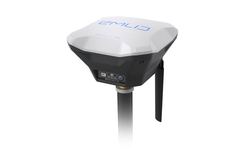
RTK GNSS modules for drones
Manufacturers in this group:
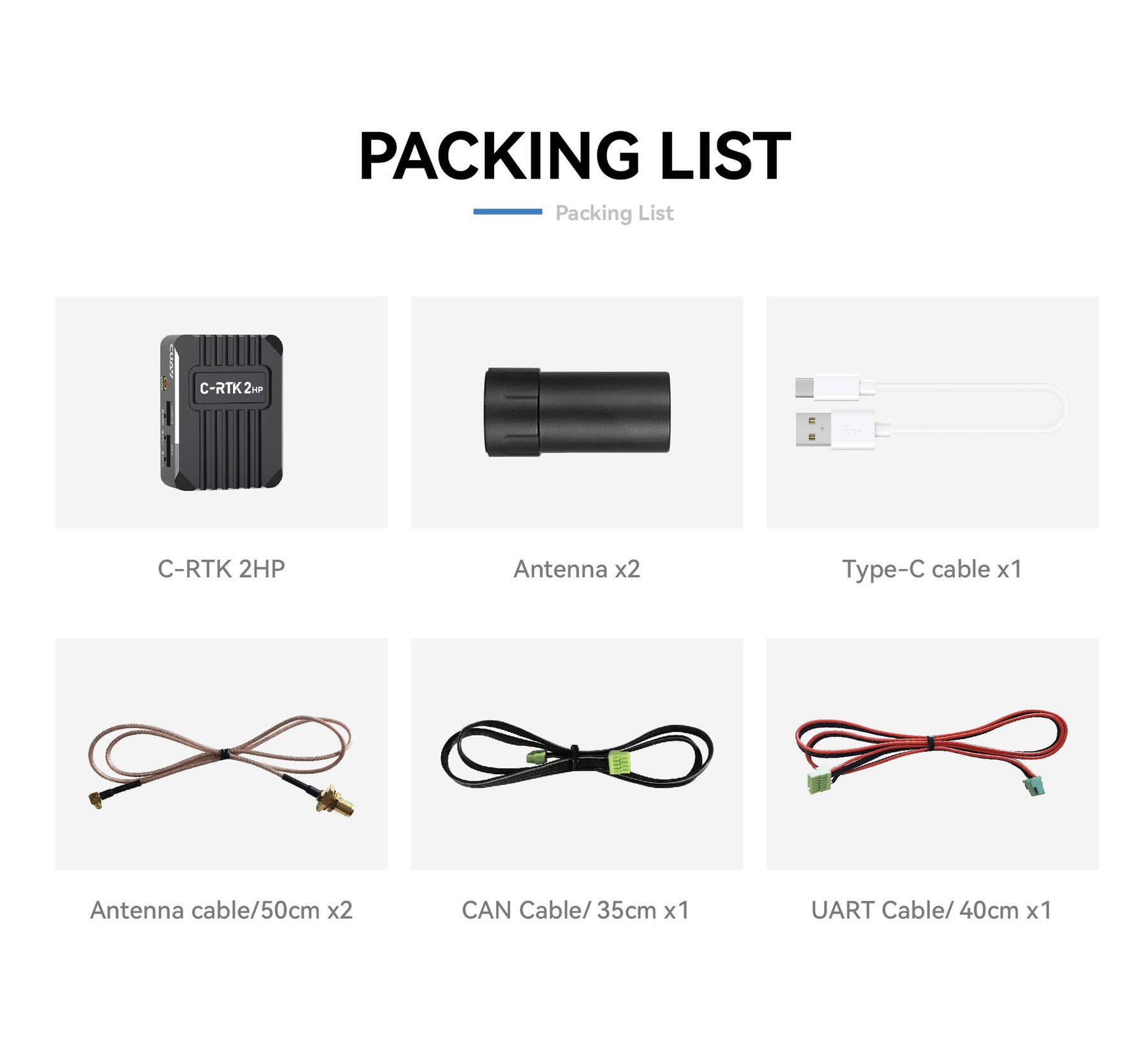 CUAV C-RTK2
RTK modules are GNSS receivers that achieve centimetre accuracy using correction data from a base station or a correction service. They are used for surveying, precision landing and multi-drone flights.
Chipset
GNSS receiver chip, such as u-blox ZED-F9P, X20 or Septentrio mosaic. The chipset determines bands, constellations and achievable accuracy; the board around it determines antenna, compass and connectors.
Frequency bands
Signal bands used, for example L1 only or additionally L2, L5 and E5a. Multi-band receivers correct ionospheric delay errors and reach RTK solutions faster and more reliably.
Horizontal accuracy (cm)
Horizontal RTK base value in centimetres, excluding the distance-dependent ppm term that grows with baseline length. Manufacturers state it either as CEP (radius containing half of the fixes) or as RMS (root mean square, about 63 % of fixes for circularly distributed errors); compare values only together with the accuracy note.
Accuracy note
The manufacturer's original statement including the measure (CEP or RMS), the ppm term and conditions. Where no figure is given, accuracy is not documented and should not be ranked.
Weight (g)
Mass of the part in grams as stated by the manufacturer. Check whether cables, mounts or accessories are included, as manufacturers report this differently.
Compass
Built-in magnetometer, such as RM3100, IST8310 or BMM150. A compass in the GNSS module sits far from power cables and motors and therefore measures with less interference.
RTK capable
True when the receiver processes RTK corrections from a base station or a correction service. Without RTK, accuracy is at metre level; with RTK, at centimetre level.
Interfaces
Connections to the flight controller, such as UART, I2C, USB or DroneCAN. CAN modules work with longer cables and several devices on one bus.
Constellations
GNSS constellations received, such as GPS, Galileo, GLONASS, BeiDou, QZSS, NavIC, plus SBAS corrections. More constellations mean more visible satellites, which helps in urban canyons and under trees.
Update rate (Hz)
How many times per second the receiver outputs a new position. Higher rates help with fast flight and precise control; the maximum often applies only to a subset of constellations.
Multi-band receivers (e.g. L1, L2, L5) obtain an RTK fix faster and more reliably than single-band receivers. Supporting more constellations helps when the view of the sky is limited. For connection to PX4 or ArduPilot, DroneCAN modules with compass are convenient; for custom integration, boards with UART and USB. Only compare accuracy together with the measure (CEP or RMS) and the ppm term. It also needs clarifying where corrections come from: own base station, radio link or a mobile-network correction service.
Accuracies are stated as CEP or RMS depending on the manufacturer and, for RTK, exclude the distance-dependent ppm term. Values are only shown together with the accuracy note and are not ranked without it.
What is the difference between CEP and RMS?
CEP is the radius containing half of the fixes. RMS is the root mean square of the deviations and, for circularly distributed errors, covers about 63 % of fixes; the same receiver therefore has a smaller CEP than RMS value.
What does the ppm term mean?
An error component that grows with the distance between base and drone. The further away the base, the more is added to the base value.
Do I need my own base station for RTK?
Not necessarily. Correction services over the internet can be used instead, provided the drone or ground station has access to them.