Parachute recovery systems for drones
Manufacturers in this group:
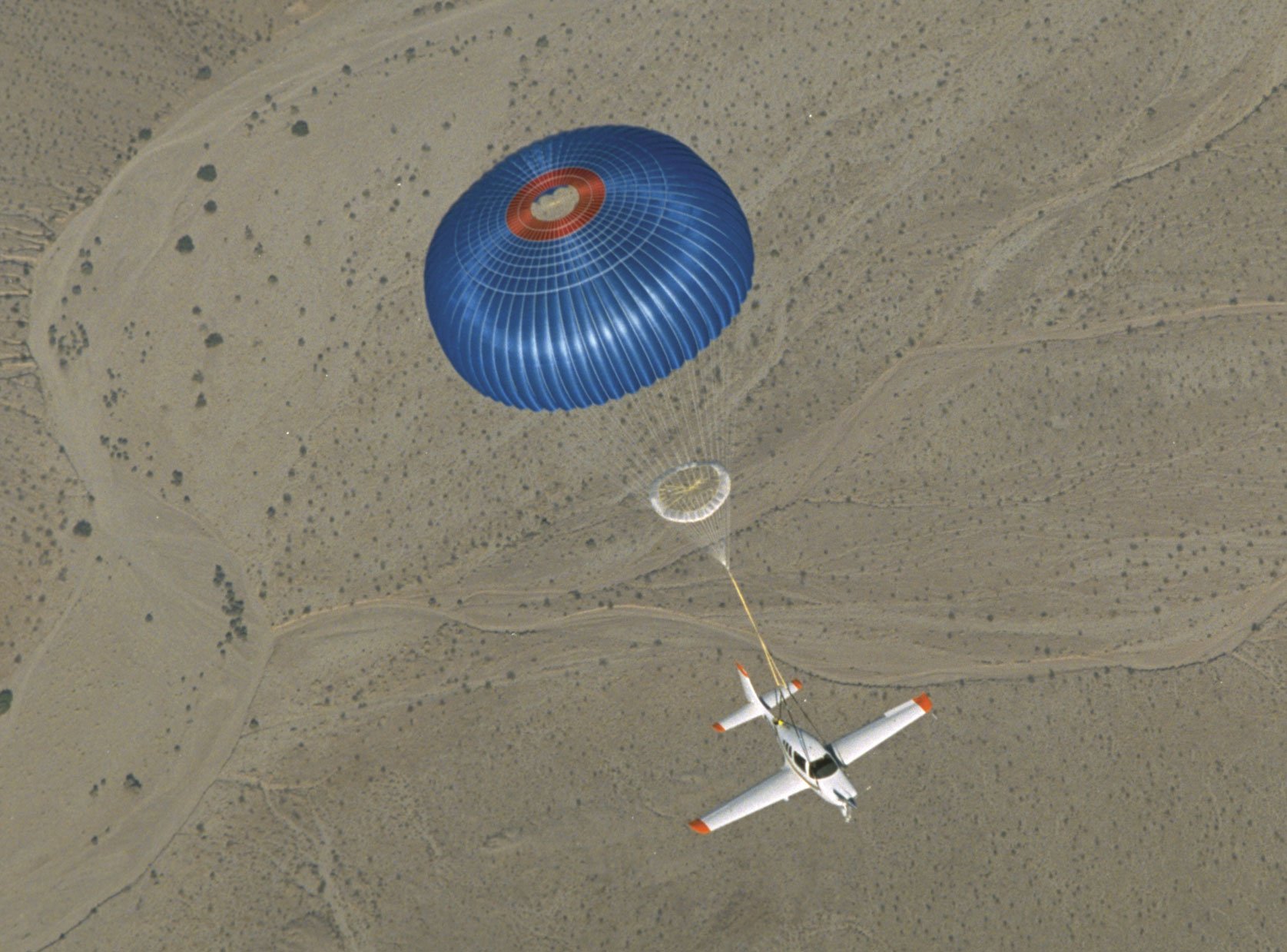 Opale Aero System SARL (Opale Paramodels / Opale Parachutes) Kit parachute Safetech ST100 + parachute 7 m2
Parachute recovery systems slow a drone down in case of failure or loss of control to reduce damage on the ground. They consist of a canopy, a deployment mechanism and usually their own monitoring electronics with motor cut-off.
Deployment method
Mechanism that ejects the canopy: ballistic, pyrotechnic, gas generator, spring mechanism or catapult. Fast deployment reduces the required minimum height; pyrotechnic systems are subject to separate transport and storage rules.
Autonomous triggering
True when the system detects a crash or abnormal attitude by itself and deploys without a pilot command. Independent detection matters for flights over people.
Motor cut-off (FTS)
Indicates whether the system cuts the motors on deployment (flight termination). Without cut-off, spinning propellers can damage the canopy.
Weight (g)
Weight of the recovery system. It counts towards take-off mass and can change the drone's classification.
Compatible with
Drone models for which the manufacturer offers a ready-made kit. For other models, manufacturer data and compliance evidence do not automatically apply.
Maximum take-off mass (kg)
Highest drone take-off mass the parachute is designed for. The drone including payload must stay below it, otherwise the descent rate increases.
Minimum deployment height (m)
Lowest height from which the parachute opens safely according to the manufacturer. Below it the system offers little protection; statements such as “deployment within x m” are not the same and were not used.
Standard compliance
Demonstrated standards or means of compliance, such as ASTM F3322 or EASA MoC Light-UAS.2511 and 2512. “Eligible for testing” or “expected” does not count as compliant and stays empty.
Descent rate (m/s)
Descent speed under canopy. Where a range is given, the value for the highest stated mass is entered; a lower descent rate means less impact energy.
The system must be designed for the drone's actual take-off mass; with a heavy payload the descent rate increases. A low minimum deployment height matters when flying low. Autonomous triggering and motor cut-off increase safety because the system does not depend on the pilot. For flights over people or in certain specific-category scenarios, evidence according to ASTM F3322 or EASA MoC Light-UAS.2511 and 2512 may be required. Ready-made kits for a specific drone model are easier to substantiate than custom adaptations.
“Standard compliance” is only set where “certified” or “compliant” is stated explicitly; “eligible for testing” or “expected” does not count.
Pyrotechnic or gas-powered deployment may be subject to separate transport and storage rules; follow the manufacturer's instructions.
ParaZero no longer lists SafeAir on its own website; values come from dealers and the press.
From what height does a drone parachute open?
The datasheet states this as the minimum deployment height, which depends on the mechanism; below it the system offers little protection.
Why does the system cut the motors?
Spinning propellers can tangle in or cut the canopy.
What is EASA MoC Light-UAS.2512?
An EASA means of compliance for recovery systems of light drones; the data only record it where the manufacturer states it explicitly.