Yanmar L-W Series
2 models in this series
Yanmar L-W Series – air-cooled single-cylinder industrial engines of the register: L70W and L100W from Yanmar's long-running L engine family for pumps, compressors and stationary drives
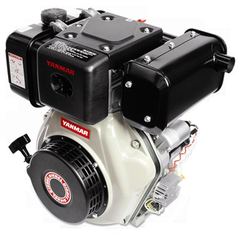
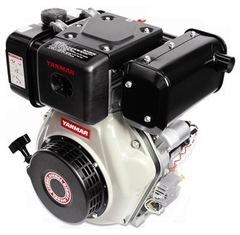
The Yanmar L-W Series brings together on this collective page two air-cooled single-cylinder diesel engines: L100W and L70W. Yanmar was founded in 1912 in Osaka and released its first series-produced small diesel engine in 1933; the L range is one of Yanmar's best-known families of air-cooled single-cylinder engines and has been built in numerous versions for decades, without needing a water-cooling circuit with a radiator, hoses and a water pump.
Read on 3 more paragraphs
The register lists here two versions, L100W and L70W, with 4.8 to 6.8 kW or 6.5 to 9.2 hp at 3,600 rpm; displacement ranges from 320 to 435 cm³, dry weight from 38 to 48.5 kg. Both are naturally aspirated, air-cooled single-cylinder diesel engines meeting the EPA/CARB Final Tier 4 emission standard.
Air-cooled single-cylinder diesel engines like the L range classically drive stationary applications such as pumps, compressors, small construction machinery and generator sets, where a simple, rugged design without a water-cooling circuit is wanted; the L range is one of Yanmar's longest-lived and most widely used engine families and is used worldwide by third-party makers as a build-in engine for irrigation pumps, tillers and simple agricultural equipment, where straightforward maintenance without water-cooling service matters most.
When buying used, what counts on these single-cylinder engines is the condition of the cooling fins and fan wheel, compression, and the condition of the fuel pump and injector; uneven running often points to wear in the injection system or valves, and a damaged fan wheel can quickly cause overheating on an air-cooled engine. Spare parts run through Yanmar's industrial engine distribution.
Sources: SpecCodex register, model data: Yanmar L-W Series, Yanmar (manufacturer)
Models
Diesel engine in 3D section
Turn the model, look inside and click an assembly — each one is explained.