Shibaura ST
9 models in this series
Shibaura ST – the Japanese compact-tractor range: 9 types from the ST 318 to the ST 460, 18 to 36 kW (24 to 48 hp), engines also supplied to Ford, New Holland and Case IH
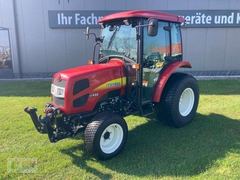
Shibaura is a Japanese maker of compact tractors and diesel engines whose units supplied other brands for decades – compact models from Ford/New Holland and Case IH, among others, ran on Shibaura engines or chassis built on Shibaura designs. The ST series spans small garden tractors through compact tractors for grounds care and smallholdings; the type number roughly tracks engine size and power class. Large volumes of Japanese production also reached Europe and North America, where compact tractors of this class became popular for grounds maintenance, orchard work and smaller hobby holdings.
Read on 3 more paragraphs
The register lists 9 variants, from the ST 318 and ST 321 to the ST 450 and ST 460, at outputs of 18 to 36 kW (24 to 48 hp); the model with full data has a four-cylinder diesel of 2,216 cc, a kerb weight of 1,905 kg, a lift capacity of 1,486 kg and a rated 2,500 rpm.
In the compact class Shibaura competes directly with Kubota, Iseki and Yanmar; outside Japan the brand is better known as an engine supplier than as a tractor name, since many ST models were sold under other companies' badges.
Buying a used compact tractor of this size, the pto and hydraulic pump matter, along with the condition of front-loader mounts, rust on the frame and leaks from the diesel engine; since identical units ran under several brand names, wear parts can often be sourced through the partner brand's distribution channels too, which keeps these tractors easier to maintain long after a given model left production.
Sources: SpecCodex register, model data: Shibaura ST
Models
Tractor in 3D section
Turn the model, look inside and click an assembly — each one is explained.
ST450
The Shibaura ST450 belongs to the ST series. The engine delivers 48 hp (36 kW), has 4 cylinders, with a displacement...
ShibauraST 324no photoST 324
With the ST 324, Shibaura offers a model from the ST series. The engine delivers 24 hp (18 kW). The engine comes...
ShibauraST 318no photoST 318
The Shibaura ST 318 is a tractor made by Shibaura.
ShibauraST 321no photoST 321
The Shibaura ST 321 is a tractor from the ST series.
ShibauraST 333no photoST 333
The Shibaura ST 333 is a tractor from the ST series.
ShibauraST 400no photoST 400
The Shibaura ST 400 is a tractor made by Shibaura.
ShibauraST 445no photoST 445
The Shibaura ST 445 is a tractor from the ST series.
ShibauraST 450no photoST 450
The Shibaura ST 450 is a tractor made by Shibaura.
ShibauraST 460no photoST 460
The Shibaura ST 460 is a tractor from the ST series.