Schlepperwerk Nordhausen RS 01
2 models in this series
Schlepperwerk Nordhausen RS 01 – the pioneer from the early GDR: RS 01/40 Pionier and RS 01/40-II Harz, four-cylinder diesel of 5,022 cm³, 29.4 to 30.9 kW at 1,250 rpm, unladen weights from 3,296 to 3,300 kg
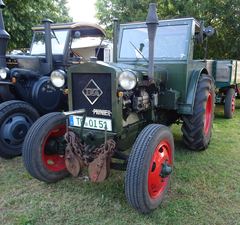
Schlepperwerk Nordhausen built the RS 01, nicknamed Pionier, in the first post-war years in the Soviet occupation zone and the early GDR, one of the first farm tractors made in post-war East Germany; the register lists here the RS 01/40 Pionier and the RS 01/40-II Harz variant. Both carry a four-cylinder diesel engine of over 5 litres that runs at a low 1,250 revolutions per minute – an engine layout typical of the period, built for pulling power rather than revs.
Read on 3 more paragraphs
The register lists here 2 versions with 29.4 to 30.9 kW from a four-cylinder of 5,022 cm³ at 1,250 revolutions per minute. Unladen weights run from 3,296 to 3,300 kg, lengths from 3,390 to 3,650 mm, widths from 1,720 to 1,725 mm and heights from 2,200 to 2,395 mm.
As one of the early tractors of post-war East German farming, the RS 01 Pionier marks the start of tractor production in what became the GDR, before production was more strongly centralised in the 1950s and later continued under, among others, VEB Fortschritt.
On a used RS 01 Pionier, the condition and compression of the slow-running four-cylinder, the tightness of the cooling system and injection pump, the state of the gearbox and steering, and corrosion on the frame, mudguards and sheet-metal parts matter; given the considerable age, a thorough technical inspection before returning it to service is essential.
Sources: SpecCodex register, model data: Schlepperwerk Nordhausen RS 01
Models
Tractor in 3D section
Turn the model, look inside and click an assembly — each one is explained.

