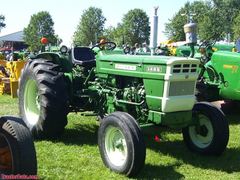
Oliver / Fiat 65 series
2 models in this series
Oliver / Fiat 65 series – tractors built in Italy for Oliver's European network: 1365 and 1465, 44.9 to 56.6 kW, four-cylinder engines of 3,456 to 4,562 cm³

Like the smaller 55 series, Oliver also had the 65 series built for the European market during the 1960s by Fiat in Italy; here too the type designation names approximately the power class in hp. It comprises the 1365 and 1465 models, the former with four-wheel drive. Here too sales ran through Oliver's European dealer network, with close technical kinship to contemporary Fiat ranges.
Read on 3 more paragraphs
The register lists here 2 versions with 44.9 to 56.6 kW from four-cylinder engines of 3,456 to 4,562 cm³, an unladen weight of 2,250 to 2,948 kg, a length of 3,099 to 3,556 mm, a width of 1,778 to 1,831 mm, a height of 1,539 to 1,748 mm, torque of 199 to 279 Nm and a rated speed of 2,100 to 2,400 rpm.
The more powerful 65 series positioned itself above the 55 series for larger arable farms and shared its engine base and chassis concept with contemporary Fiat tractors of the same power class. As the more powerful version, the 65 series competed directly with other mid-to-large standard tractors of the 1960s in Western Europe.
Buyers of used units should check the clutch, gearbox and, on the four-wheel-drive version, the front axle, as well as the hydraulics, brakes and rust on the bodywork; because production has ended, spares run mostly through Fiat parts stocks and specialist vintage-tractor dealers. An inspection should also check the alternator, starter motor and the seals on the engine and gearbox.
Sources: SpecCodex register, model data: Oliver / Fiat 65er-Baureihe
Models
Tractor in 3D section
Turn the model, look inside and click an assembly — each one is explained.