Iveco/romcar Other models
1 model in this series
Iveco 50C/35 (Romcar) – chassis-cab with dual rear wheels, 4.75 m wheelbase, 3,500 kg gross weight and a third-party body
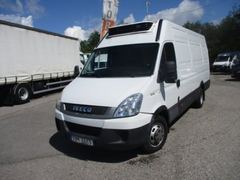
The 50C/35 type designation in the Iveco Daily range uses the letter C to denote the chassis-cab version with dual wheels on the rear axle rather than the single wheels of the S variants; the 35 in the second part of the code matches the gross vehicle weight of 3,500 kg on record. The operator Romcar fitted its own body onto this chassis, as is common for chassis-cab units in this class: cab from the vehicle manufacturer, body built to the purpose required.
Read on 3 more paragraphs
The four-cylinder diesel engine has a displacement of 2,998 cm³. At a gross vehicle weight of 3,500 kg against an unladen weight of 2,975 kg, 525 kg remain for body and load. The 4.75 m wheelbase is the longest figure on record in this chassis class, the overall length is 7.02 m, the width is 2.21 m, and the permitted top speed is given as 160 km/h.
At 3,500 kg gross weight the vehicle falls into EU class N1 and can be driven on a category B licence provided body weight and load together do not exceed the remaining 525 kg. The unusually long wheelbase combined with a comparatively short overall length points to a body that makes full use of the space between the axles rather than overhanging far behind the rear axle. Dual rear wheels spread the body's high unladen weight across four tyres, increasing stability compared with single wheels.
When buying a used chassis-cab vehicle with such a long wheelbase, it is worth checking the frame for flexing between the axles, since a long wheelbase under heavy loading is more exposed to torsional stress. With dual wheels, matching tyre pressure and tread depth on both tyres per side should be checked. Since the remaining payload of 525 kg is small, the actual unladen weight should also be weighed to reliably rule out overloading in everyday use.
Sources: SpecCodex-Register: Kennwerte des Modells 50C/35
Models
Van in 3D section
Turn the model, look inside and click an assembly — each one is explained.
