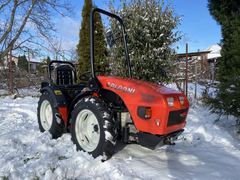
Goldoni Base
2 models in this series
Goldoni Base: compact entry-level tractors from Migliarina di Carpi, Base 20 with two-cylinder diesel engine, around 15 to 16 kW / 20 hp, 750 kg unladen weight

The Base series forms Goldoni's entry-level segment, the Italian specialist in small and specialty tractors founded in 1926 in Migliarina di Carpi near Modena. The Base 20 is a light, narrow two-wheel-drive tractor for small holdings, orchards and vineyards, powered by a two-cylinder diesel engine; the name Base 20 refers to the engine's rated output of around 20 hp. Alongside the Base series, Goldoni still builds mainly specialty tractors for vineyards, orchards and other steep terrain, where narrow track widths and a small turning circle matter.
Read on 3 more paragraphs
The register lists 2 versions here with 15 to 16 kW (around 20 hp) from two-cylinder engines of 954 to 955.4 cm³, an unladen weight of 750 kg, a length of 2,500 mm, a width of 815 mm and a roll-bar height of 1,757 mm at a rated speed of 3,000 rpm.
With its low weight and narrow build, the Base 20 is aimed at small holdings, hobby farmers and work in tight row crops, where it serves as a lower-cost alternative to the brand's larger, specialised narrow-track tractors. The simple mechanical build without a cab keeps purchase and running costs comparatively low.
When buying one of these small two-cylinder tractors, attention should go to the condition of the engine and clutch, the tightness of the hydraulics, rust on the frame, and the function of the pto and roll bar, as well as the steering and brakes, which act directly and mechanically on these light two-wheel-drive tractors; spare parts are available through Goldoni's Italian dealer network.
Sources: SpecCodex register, model data: Goldoni Base, Goldoni (manufacturer)
Models
Tractor in 3D section
Turn the model, look inside and click an assembly — each one is explained.