Fscurtis Other models
10 models in this series
FS-Curtis – other models: the collective page for compressor drive motors outside the named series, frame sizes 90 to 200, 1.3 to 37 kW, two- to six-pole, made in China, 415 V
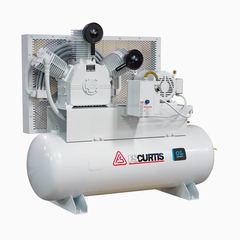
This page gathers three-phase motors listed in the register under the name of the US compressor manufacturer FS-Curtis. The type plates follow the Y2 platform widely used in China, a nationwide standard range of three-phase induction motors, as seen in designations such as Y2-160L-2 and Y2-200L2-2; only one model carries a different designation, YLS-1300W-6P. FS-Curtis has built piston and screw compressors since the 19th century and registers the associated drive motors for the Australian and New Zealand market under its own name.
Read on 3 more paragraphs
The register lists 10 versions with 1.3 to 37 kW rated output, two- to six-pole, at a uniform supply voltage of 415 V. Full-load efficiency ranges from 79.8 to 92.62%, and at 75% load from 77 to 92.42%. Frame sizes span 90 to 200, and the protection class ranges from IP44 to IP55.
As a compressor drive, these motors must withstand often continuous full-load operation and the mechanical load from the belt or direct drive of the compression stage. The uniform 415 V supply voltage matches the industrial three-phase mains customary in Australia and New Zealand.
For a replacement, these compressor motors call above all for matching the shaft end and pulley diameter to the existing compressor, plus checking bearing condition, which is additionally radially loaded by belt tension. The predominant B3 mounting code simplifies replacement with other power ratings within the same range.
Sources: SpecCodex register, model data: FS-Curtis (weitere Modelle), Zulassungsdaten GEMS/MEPS (Australien, Neuseeland)
Models
Electric motor in 3D section
Turn the model, look inside and click an assembly — each one is explained.
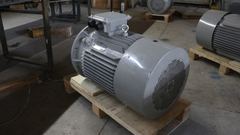
Y2-132S-2
Fscurtis lists the Y2-132S-2 as a three-phase induction motor. The rated output is 4 kW. The motor is two-pole,...
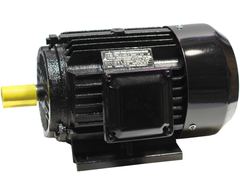
Y2-132S1-2
The Fscurtis Y2-132S1-2 is a three-phase induction motor from the Fscurtis range. The rated output is 5.5 kW. The...
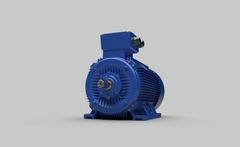
Y2-160L-4
The Fscurtis Y2-160L-4 is a three-phase induction motor. The rated output is 15 kW. The motor is four-pole, which at...

Y2-160M-2
The Y2-160M-2 from Fscurtis is a three-phase induction motor. The rated output is 7.5 kW. The motor is two-pole,...

Y2-160M1-2
Fscurtis lists the Y2-160M1-2 as a three-phase induction motor. The rated output is 11 kW. The motor is two-pole,...

Y2-180M-2
The Fscurtis Y2-180M-2 is a three-phase induction motor from the Fscurtis range. The rated output is 22 kW. The...

Y2-200L-4
The Fscurtis Y2-200L-4 is a three-phase induction motor built by Fscurtis. The rated output is 30 kW. The motor is...
YLS-1300W-6P
The YLS-1300W-6P from Fscurtis is a three-phase induction motor. The rated output is 1.3 kW. The motor is six-pole,...
FscurtisY2-160L-2no photoY2-160L-2
The Fscurtis Y2-160L-2 is a three-phase induction motor built by Fscurtis. The rated output is 18.5 kW. The motor is...
FscurtisY2-200L2-2no photoY2-200L2-2
The Fscurtis Y2-200L2-2 is a three-phase induction motor. The rated output is 37 kW. The motor is two-pole, which at...
