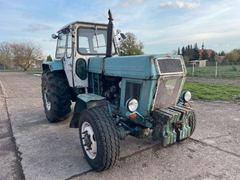
Fortschritt Universaltraktor ZT
2 models in this series
Fortschritt Universaltraktor ZT: successor to the RS09 from Schönebeck, ZT 300 and ZT 303 with four-cylinder engines, around 70 to 74 kW, from the late 1960s

The Universaltraktor ZT replaced the RS09 as East German agriculture's standard tractor at VEB Traktorenwerk Schönebeck from the late 1960s and was sold under the Fortschritt umbrella brand, a state combine that bundled several East German farm-machinery plants under one name. The ZT 300 formed the series' first version, while the later ZT 303 was a more powerful development on essentially the same chassis and four-cylinder engine. Both models had the classic standard-tractor layout with a rear pto and hydraulic lift, built for universal field work.
Read on 3 more paragraphs
The register lists 2 versions here with around 69.9 to 73.5 kW from four-cylinder engines of 6,560 cm³, unladen weights of 4,820 to 5,255 kg, a length of 4,690 mm, a width of 2,020 mm and heights of 1,800 to 2,780 mm over the bonnet.
As East Germany's most widely built standard tractor, the ZT shaped the mechanisation of agricultural production cooperatives for two decades and was also exported to other Eastern Bloc states, where it ranked alongside Soviet Belarus tractors among the most common four-cylinder standard tractors. Its simple, rugged build kept it in use on small farms across central and eastern Europe long after East German agriculture had ended.
When buying one of these rugged four-cylinder tractors, attention should go to the condition of the engine and injection system, the tightness of the cooling system and hydraulics, rust on the fenders and cab, and the condition of the clutch and transmission; checking the pto and lift-control function is also part of the inspection; spare parts today are mostly sourced through vintage-tractor specialists and former Eastern Bloc networks.
Sources: SpecCodex register, model data: Fortschritt Universaltraktor ZT
Models
Tractor in 3D section
Turn the model, look inside and click an assembly — each one is explained.