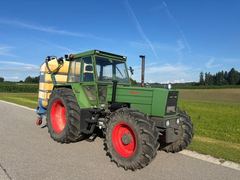
Fendt Favorit 600 LS/LSA
1974–1986 · 2 models in this series
Fendt Favorit 600 LS/LSA – large six-cylinder range from Marktoberdorf of the 1970s/80s: 6,240 to 11,407 cm³ displacement, 466 Nm torque, 6,360 to 9,600 kg unladen weight
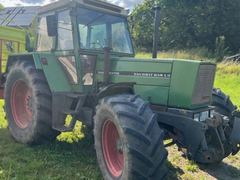
The Favorit range replaced the smaller Farmer tractors at the top of Fendt's Marktoberdorf line-up from the 1970s and grew by the 1980s into large, cab-equipped six-cylinder tractors. In the range's letter codes, L marks the more comfortable Luxus specification and the additional A four-wheel drive, so the LSA version is the four-wheel-drive variant of the corresponding LS model.
Read on 3 more paragraphs
The register lists here 2 six-cylinder versions of 6,240 to 11,407 cm³ displacement, torque of 466 Nm at 2,400 rpm, unladen weights from 6,360 to 9,600 kg, a length of 4,684 mm, a width of 2,420 mm and a height of 2,859 mm.
The Favorit range positioned Fendt in the 1970s and 1980s as a maker of large, comfortable tractors for better-off farms in West Germany and became the technical and commercial basis on which Fendt later took the lead in the premium segment with the stepless Vario transmission. The successor introduced in 1995, the Favorit 926 Vario, was the world's first series-production tractor with a stepless transmission.
On the big used Favorit 600 tractors, condition of injection pump and turbocharger, tightness and shift behaviour of the gearbox, condition of cab mounting and seals, and rust on mudguards and stub axles count; parts for the mechanical base are available through Fendt dealer workshops and specialist classic-tractor traders.
Sources: SpecCodex register, model data: Fendt Favorit 600 LS/LSA, Fendt (AGCO, Hersteller)
Models
Tractor in 3D section
Turn the model, look inside and click an assembly — each one is explained.