Brinkman & Havinga Other models
2 models in this series
Brinkman & Havinga De Wouden 001 – EU class O2 trailer: 3,500 kg gross vehicle weight, 960 kg unladen weight, 4,300 mm wheelbase, 2,220 mm wide, built 2013
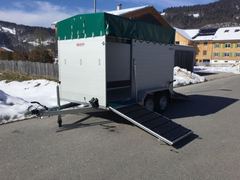
With a gross vehicle weight of 3,500 kg, the Brinkman & Havinga De Wouden 001 falls into EU trailer class O2, trailers between 750 kg and 3.5 tonnes. Trailers in this class usually run on an overrun brake: when the towing vehicle brakes, the drawbar compresses slightly and mechanically applies the trailer's brakes, with no separate brake line to the towing vehicle.
Read on 3 more paragraphs
The Brinkman & Havinga De Wouden 001 was built in 2013 and has an unladen weight of 960 kg; against a gross vehicle weight of 3,500 kg, that leaves a payload of 2,540 kg. Width is 2,220 mm. The wheelbase is 4,300 mm, spread across 6 wheels. The permitted top speed is 100 km/h.
Trailers in this weight class are towed behind cars and light commercial vehicles for haulage and leisure use. The overrun brake needs no separate brake line to the towing vehicle, but does need a smooth-running, corrosion-free override mechanism and a working reversing lock so it does not brake unintentionally when reversing. The ratio of unladen weight to payload is within the usual range for this class.
When buying used, a trailer in this class lives or dies on the override mechanism: it must compress and extend smoothly, with no play or corrosion in the guide. The checklist should also cover brake cables, linings and the reversing lock, axle bearings, tyres and tread depth, the frame and floor for rust or damp, and the lighting. That also means checking the spare-parts supply for brakes and axles.
Sources: SpecCodex-Register: Kennwerte des Modells Brinkman & Havinga De Wouden 001
Models
Trailer in 3D section
Turn the model, look inside and click an assembly — each one is explained.
DE WOUDEN 001
The DE WOUDEN 001 comes from Brinkman & Havinga. Production: 2013. The vehicle is 2,220 mm wide. The unladen weight...
Brinkman & HavingaDE WOUDEN 005no photoDE WOUDEN 005
DE WOUDEN 005 comes from the manufacturer Brinkman & Havinga. According to the available register data, the vehicle...
