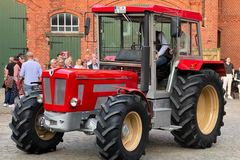
Aton Schlüter Abtschlepperbau München GZ
2 models in this series
Anton Schlüter Munich GZ – the post-war wood-gas tractors: GZA 25 and GZV 25, 18.3 kW two-cylinder of 3,982 cc, a gas generator instead of a diesel tank
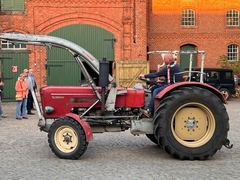
Anton Schlüter of Munich was one of the traditional Bavarian farm-machinery makers and, in the post-war years, built wood-gas tractors alongside diesel ones, when diesel fuel was rationed and scarce. The GZ series – GZA 25 and GZV 25 – ran on a gas generator burning gas produced from wood instead of a diesel tank, a common stopgap for farm tractors in the 1940s.
Read on 3 more paragraphs
The register lists 2 variants at 18.3 kW from a two-cylinder engine of 3,982 cc, a kerb weight of 2,200 kg, lengths of 3,200 to 3,400 mm, a width of 1,600 mm and heights of 1,750 to 1,900 mm at a rated 1,500 rpm.
Wood-gas tractors such as the GZ series bridged the shortage of liquid fuel in Bavarian farming in the immediate post-war years; the gas generator replaced the diesel tank with a wood gasifier that demanded more manual attention and maintenance than an ordinary diesel engine. As fuel supply normalised through the 1950s, such conversions quickly disappeared from the market and plain diesel tractors again became the rule.
Surviving examples are collectors' pieces today; what matters is the condition of the gas generator and its piping, tightness and corrosion on the gas-carrying parts, and – as with any tractor of this age – the clutch, gearbox and condition of the sheet metal. Parts for the tractor itself circulate through vintage-vehicle channels, while gas-plant components are made individually to order.
Sources: SpecCodex register, model data: Anton Schlüter München GZ
Models
Tractor in 3D section
Turn the model, look inside and click an assembly — each one is explained.