Antonio Carraro Ergit 100
2 models in this series
Antonio Carraro Ergit 100 SRX 9800: the compact tractor from the Italian specialty-crop maker near Padua, a four-cylinder diesel of 3,300 cm³, 64 kW at 2,500 rpm, built in 2017
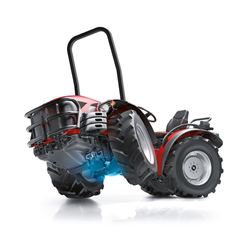
Antonio Carraro is an Italian family business from the area around Padua in the Veneto, specialising in compact tractors for specialty crops such as vineyards and orchards as well as municipal use. The Ergit 100 SRX 9800 is a model in this line from 2017.
Read on 3 more paragraphs
The engine is a water-cooled four-cylinder diesel of 3,300 cm³ producing 64 kW (87 hp) at 2,500 rpm. This combination of four cylinders and a medium displacement is a strong yet still manageable motorisation for a compact tractor, without reaching the weight class of a standard tractor.
Water-cooled four-cylinders in this power class suit compact tractors working on smaller, often irregularly shaped plots, where manoeuvrability and a good power-to-size ratio matter more than sheer draft force for large implements. For specialty-crop makers such as Antonio Carraro, this also means the vehicles are often built with a narrow track and a low centre of gravity for working between tight rows.
When buying a used compact tractor of this type, what matters most is the engine's operating hours, the condition of the hydraulic couplings for frequently changed implements, the steering and steering knuckles given heavy manoeuvring, and rust on sheet-metal parts if the machine has been in contact with crop-protection chemicals in a vineyard or orchard. Spare parts run through the Antonio Carraro dealer network.
Sources: SpecCodex-Register: Kennwerte des Modells Ergit 100 SRX 9800, Antonio Carraro (manufacturer)
Models
Tractor in 3D section
Turn the model, look inside and click an assembly — each one is explained.