Allgaier AP 25
1 model in this series
Allgaier P 312 – tractor of the AP 25 range from Uhingen to a Porsche design (1953–1954): air-cooled twin-cylinder petrol engine with 1,820 cm³ displacement, 22.1 kW/30 hp
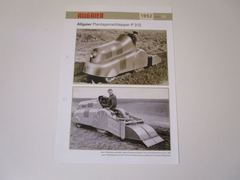
Allgaier-Werke of Uhingen in Baden-Württemberg built tractors to designs by Ferdinand Porsche from the late 1940s, before production later passed to Porsche-Diesel. The P in the type designation P 312 refers to this Porsche design; the P 312 belonged to the AP 25 range built from 1953 to 1954. The Porsche systems across the Allgaier ranges differed mainly in cylinder count and displacement but remained technically closely related and shared many components.
Read on 3 more paragraphs
The P 312 is powered by an air-cooled twin-cylinder petrol engine with 1,820 cm³ displacement, producing 22.1 kW or 30 hp at 2,000 rpm. The machine is 2,900 mm long, 1,090 mm wide and 1,550 mm high, has a wheelbase of 1,656 mm, an unladen weight of 1,275 kg and reaches 23 km/h.
At 23 km/h, the P 312 falls into driving licence category L. Unusual for a tractor of this period is the petrol engine rather than a diesel; air cooling does away with a radiator and water pump and fits the simple, robust layout of the early Porsche designs. The combination of a petrol engine with air cooling made the P 312 independent of a functioning liquid cooling supply, which also made it practical for use in frosty conditions.
On this tractor, now over seventy years old, check the carburettor and ignition system of the petrol engine, the cylinder's cooling fins for cracks and damage, and the steering and chassis for age-related wear; parts come almost exclusively from suppliers specialising in Porsche-Diesel and Allgaier classics.
Sources: SpecCodex-Register: Kennwerte des Modells Allgaier P 312
Models
Tractor in 3D section
Turn the model, look inside and click an assembly — each one is explained.