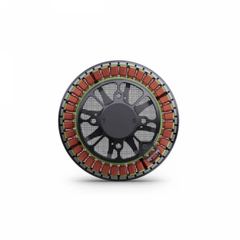
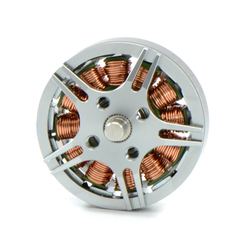
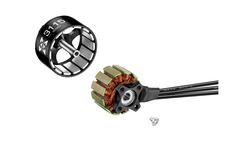
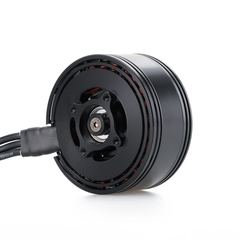
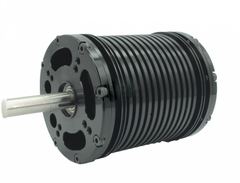
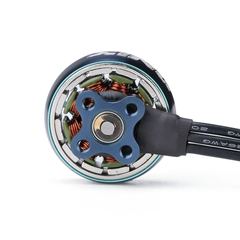
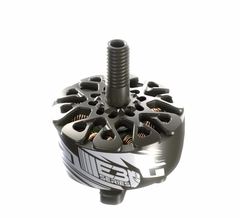
Brushless motors for drones
Manufacturers in this group:
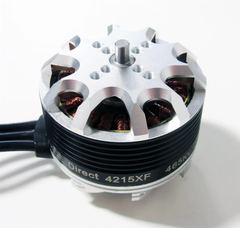
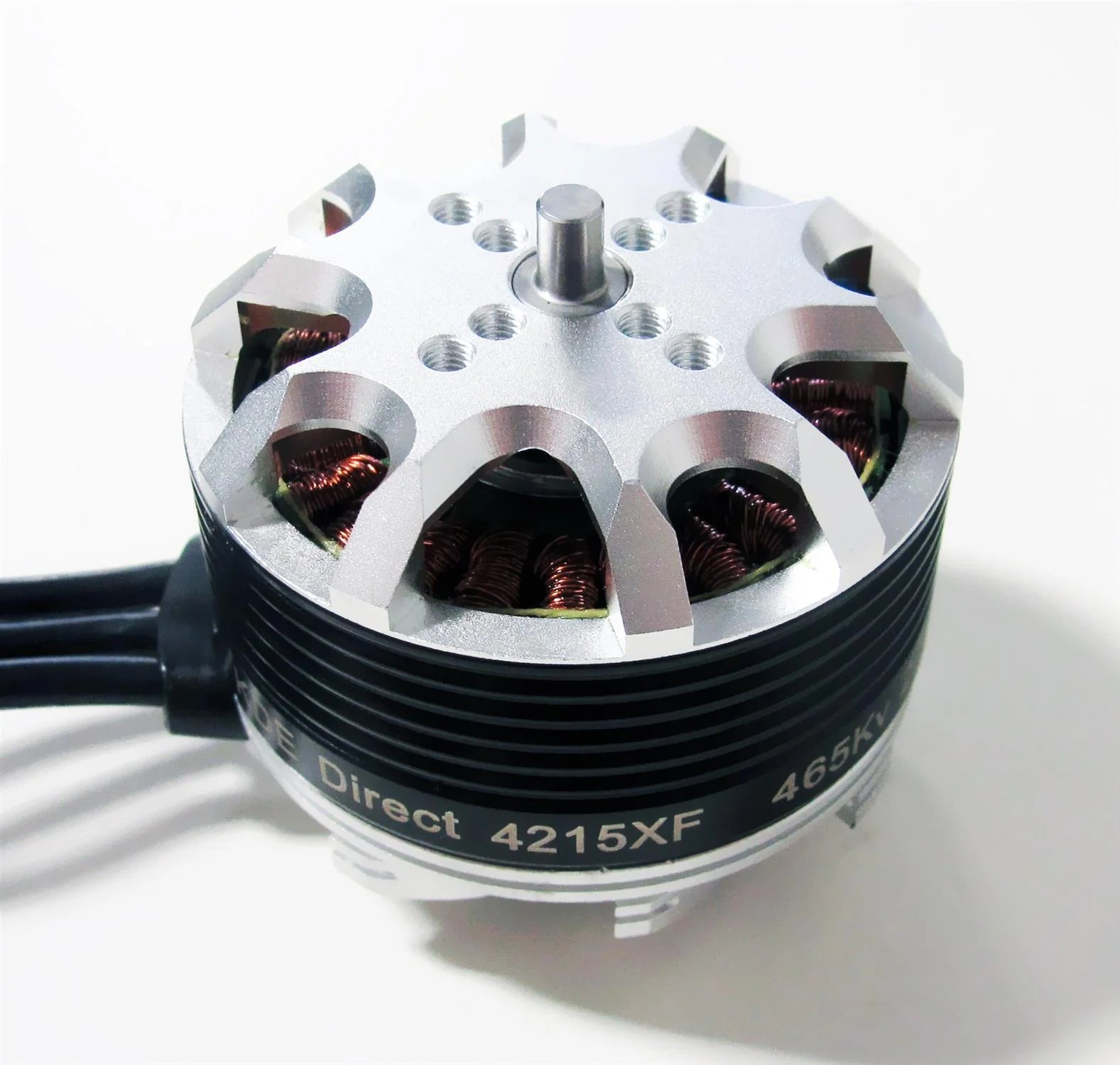 KDE Direct KDE4215XF-465
Brushless motors drive the propellers of multirotors and fixed-wing drones. They work without brushes and are commutated electronically by the ESC, which makes them efficient and low-maintenance.
Dimensions (mm)
Outer diameter by height of the motor in millimetres. Together with the bolt pattern it determines whether the motor fits the arm.
Weight (g)
Mass of the part in grams as stated by the manufacturer. Check whether cables, mounts or accessories are included, as manufacturers report this differently.
KV (rpm per volt)
Speed constant: no-load speed per volt of battery voltage. A low KV suits large propellers and high cell counts, a high KV suits small propellers, for example on FPV drones.
Power rating time base (s)
Period in seconds for which the manufacturer states maximum power and maximum current; empty if not given. Manufacturers use different time bases (10 to 180 s in the data), so only compare power and current at the same time base.
Maximum power (W)
Highest electrical power the motor can handle for a specified period according to the manufacturer. Manufacturers use different time bases, so only compare values with the stated time base.
Maximum thrust test condition
Voltage, propeller, current and power at which the highest thrust value was measured. For KDE the values come, according to the data, from a test stand at 3,500 ft altitude, i.e. in thinner air than at sea level.
Maximum thrust (g)
Highest published thrust of a single motor with the stated propeller. Test conditions differ by manufacturer; for KDE it is the highest value from the test stand at 3,500 ft; for sizing, partial-throttle thrust matters.
Maximum current (A)
Highest current the motor may draw over the period stated by the manufacturer. The ESC must be able to supply this current continuously with a margin.
Recommended propeller
Propeller size or specific propeller model named by the manufacturer. A much larger propeller overloads the motor and the ESC.
Thrust at sea level, estimated (g)
Thrust extrapolated by KDE to sea level, because its test stand is at 3,500 ft. It is a manufacturer estimate, not a measurement; it suits comparison with other brands better than the altitude value but remains an approximation.
Cell count (S)
Permitted battery voltage expressed as the number of cells in series (the “S” rating). At the same KV the motor spins faster with more cells; motor, ESC and battery must all match the same cell count.
Stator diameter (mm)
Stator diameter in millimetres, only given where the manufacturer states stator dimensions or a stator class. It is the comparable figure behind the type code; a larger diameter delivers more torque.
Stator height (mm)
Height of the stator stack in millimetres, only given where the manufacturer states it. A taller stator at the same diameter gives more power but makes the motor heavier.
Stator size
Diameter and height of the stator, usually given as a four-digit type code (the first two digits are the diameter, the last ones the height in mm). The data contain either the type code or diameter by height; a larger stator delivers more torque for larger propellers.
Slots and poles
Number of stator slots (S) and magnet poles (P), for example 24S22P. More poles give more torque at low speed and suit large propellers; “HE” is a KDE manufacturer designation.
Efficiency at maximum thrust (g/W)
Thrust per watt of electrical power at the maximum thrust point. In hover at partial throttle, efficiency is usually much higher; for flight time the value at hover thrust is more meaningful.
The starting point is the planned take-off mass and a propeller that fits the frame. Stator size and KV follow from these: large propellers need large stators and a low KV, small FPV propellers small stators and a high KV. In the data the range spans FPV motors with stators such as 2207 up to heavy-lift motors such as 13218. The cell count of motor, ESC and battery must match. Only compare power and current at the same time base, and weight partial-throttle thrust more heavily than the peak figure.
Power and current figures refer to different time bases depending on the manufacturer (10 to 180 s according to the data, field “Power rating time base”). They are only shown together with the time base and are not ranked.
According to the data, KDE measures thrust on a test stand at 3,500 ft altitude; the sea-level value is an extrapolation by KDE. KDE thrust figures are therefore not directly comparable with other manufacturers' measurements.
The stator designation is inconsistent in the data (type code or dimensions); the separate stator diameter and stator height fields are comparable.
What does KV mean on a drone motor?
KV is the no-load speed per volt of battery voltage. It says nothing about power, but about which propeller size and cell count the motor suits.
Why are thrust figures from different manufacturers hard to compare?
Manufacturers test with different propellers, voltages and test stands, and some publish only the highest test result.
Can I run a motor on more cells than specified?
No. Above the approved cell count, speed, current and temperature exceed the design limits, which can damage the motor and ESC.