Chargers for drone batteries
Manufacturers in this group:
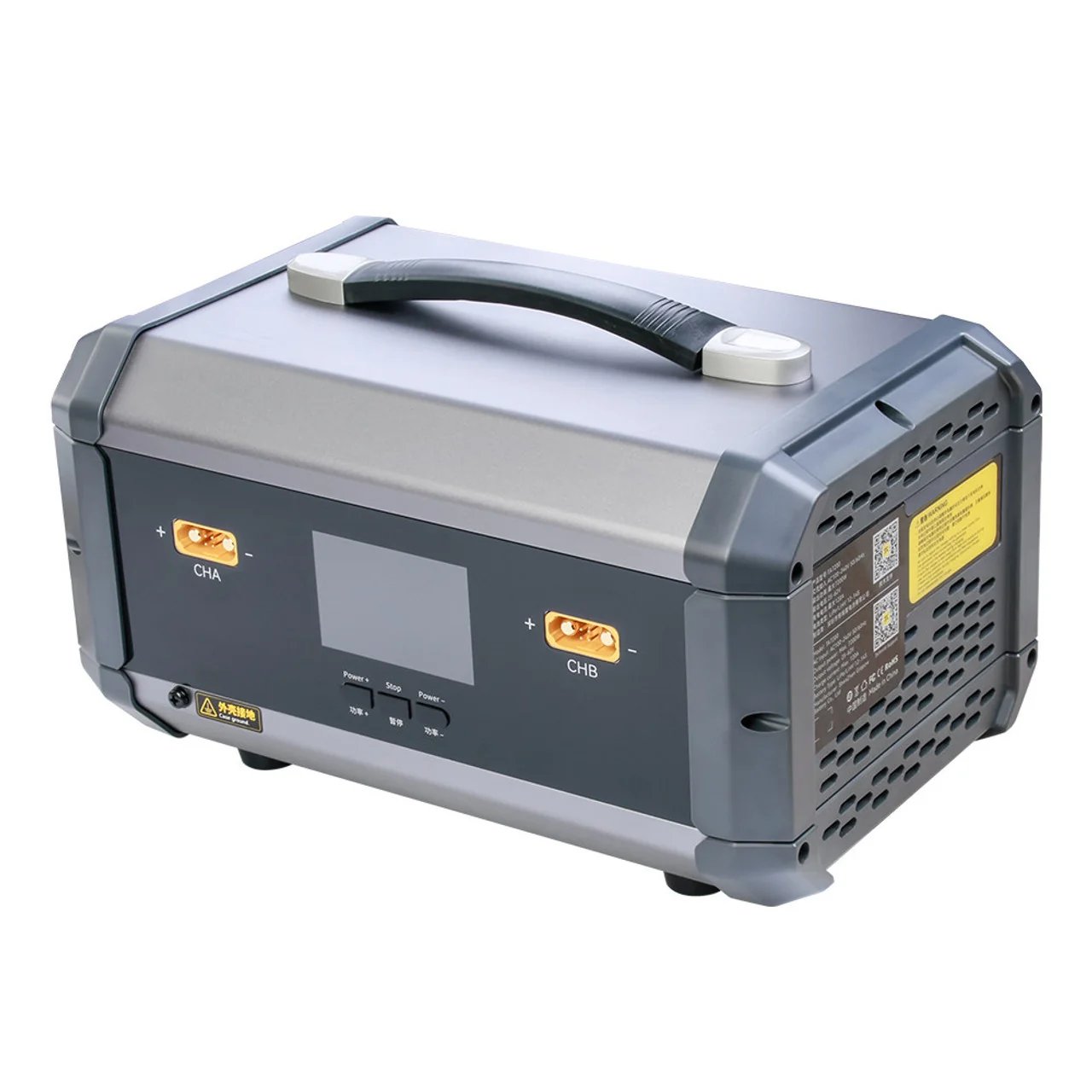 Tattu (Marke von Grepow) TA7200 PRO
Chargers for drone batteries charge lithium packs while equalising the voltage of the individual cells (balancing). For industrial drones there are powerful multi-channel units that also handle smart batteries with their own electronics.
Dimensions (mm)
External dimensions of the charger in millimetres. Important for transport cases and vehicle installation; ventilation openings must remain clear.
Battery types
Supported cell chemistries and battery types, such as LiPo, LiHV or smart batteries with CAN communication. Smart batteries need a charger that speaks their protocol; LiHV batteries need the appropriate higher end-of-charge voltage.
Input
Power supply of the charger: AC mains and in some cases DC, for example from a vehicle or generator. A DC input is practical in the field; “kein Drehstrom” (no three-phase) means an ordinary single-phase connection is enough.
Weight (g)
Weight of the charger. For mobile use, weight and dimensions count together with whether a generator or vehicle can supply the required power.
Charging channels
Number of batteries that can be charged simultaneously and independently. Multi-channel units save time in the field, but total power is shared.
Maximum charging current (A)
Highest charging current per channel or in total according to the manufacturer. The charging current permitted in the battery datasheet takes precedence; higher currents shorten charging time but stress the cells.
Maximum charging power (W)
Highest output power of the charger. It limits how fast large packs can be charged; with several channels it is usually shared, and from mains it may be lower than from DC.
Cell count (S)
Cell counts the charger can handle, such as 6S or 12S to 24S. It must match the cell count of your packs; variants of one device may have different ranges.
First, cell count and battery type must match your packs, and for smart batteries also the communication protocol. Charging power determines the charging time of large packs; with several channels it is shared. For field use, a DC input or operation from a generator with sufficient power is important. The charging current must not exceed the value permitted in the battery datasheet. Weight and dimensions matter when the unit travels in a vehicle or case.
Charge lithium batteries only according to the manufacturer's instructions, under supervision and on a non-flammable surface; do not charge damaged or swollen packs.
The stated maximum power sometimes applies only with DC input or is shared across all channels.
How long does it take to charge a drone battery?
It depends on the pack's energy, the charging power and the permitted charging current. Roughly: energy in Wh divided by available charging power, plus time for balancing.
What is a smart battery?
A pack with its own electronics that stores cell condition and charge cycles and communicates with the charger, often via CAN.
Can I charge LiHV batteries with any charger?
No, the charger must support the higher end-of-charge voltage of LiHV and be set correctly.