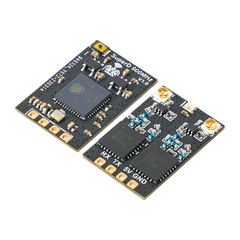
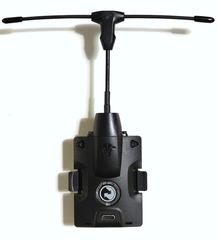
Control links for drones (radio control link)
Manufacturers in this group:
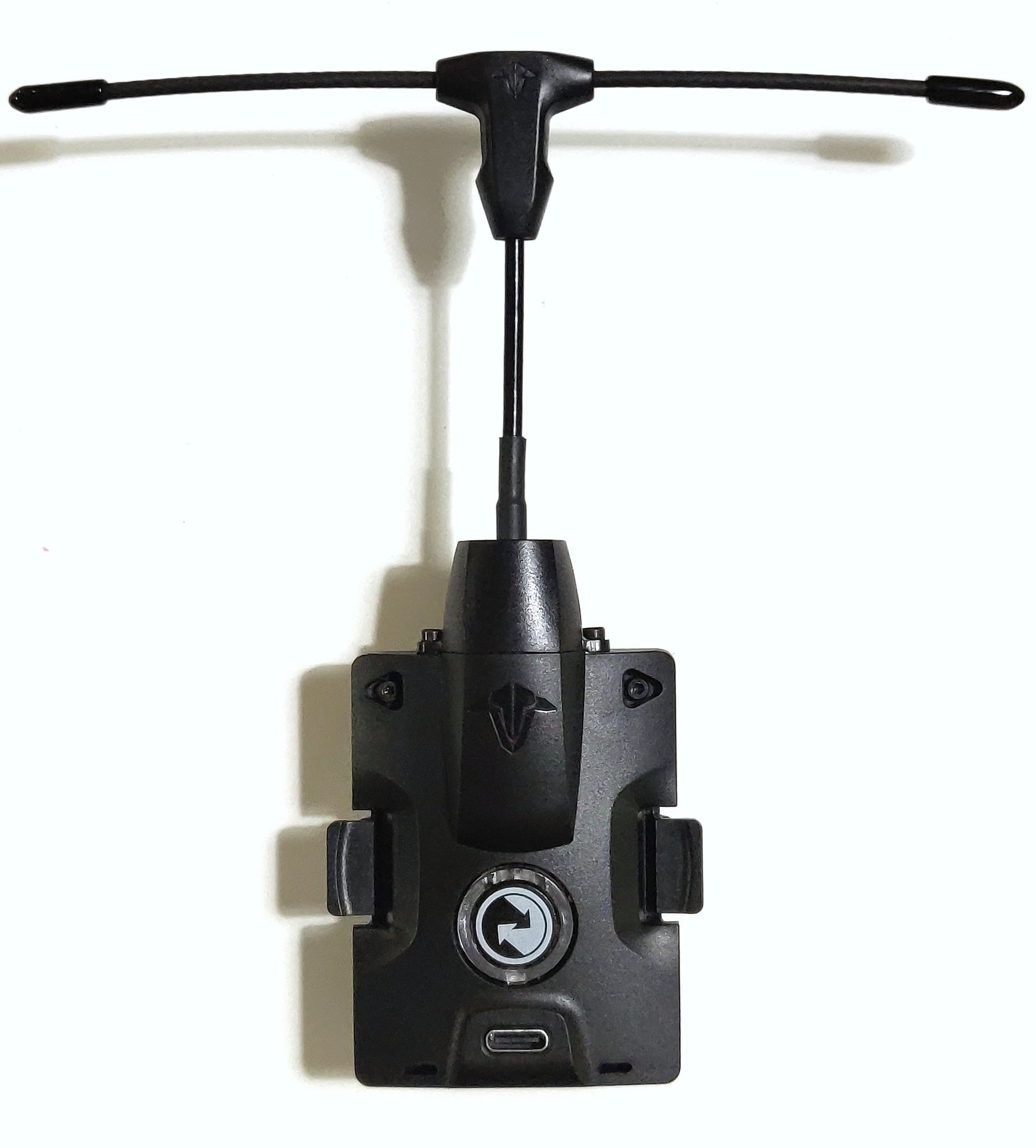 Team BlackSheep (TBS) TBS Tracer Nano RX
The control link carries commands from the transmitter to the drone and often telemetry back. Common systems are ExpressLRS, TBS Crossfire and Tracer, as well as mesh radio modules for professional systems.
Resolution
Not relevant for control links and therefore not given in the data; the field is shared with video links.
Frame rate (fps)
Not relevant for control links and therefore not given. The control link's update rate appears as packet rate under “Channels or bandwidth”.
Frequency
Radio band used, such as 2.4 GHz, 5.8 GHz or 868/915 MHz. Lower frequencies penetrate obstacles better; not every band and channel plan is permitted in the EU.
Weight (g)
Weight of the air unit (transmitter or receiver on the drone), usually without antenna and cables.
Channels or bandwidth
Depending on the system, the number of channels, channel width, bit rate or packet rate. A higher bit rate improves the image; a higher packet rate shortens the response time of the control link.
Latency (ms)
Delay between capture or control command and arrival at the receiver. For FPV flight, low and consistent latency matters more than high resolution.
Protocol
Transmission system, such as DJI O3/O4, Walksnail Avatar, HDZero, ExpressLRS or TBS Crossfire. Transmitter and receiver must use the same protocol; ExpressLRS is an open protocol used by several hardware vendors.
Range stated by manufacturer (km)
Largest manufacturer figure, usually under US conditions (FCC) and clear line of sight. Under CE rules the range is often much shorter (values in the note); in the open category visual line of sight applies anyway.
Transmit power (mW)
Radiated power in milliwatts. For DJI and Walksnail it is the converted FCC upper limit, not a measurement; permitted values in the EU are lower, and the CE values are in the note.
The transmitter module and the receiver in the drone must use the same protocol and band. 2.4 GHz offers high packet rates and low latency; 868 MHz offers greater range and better penetration, but not every variant is approved in the EU. A high packet rate shortens response time, a lower one increases range. Receivers with telemetry report signal strength and battery voltage back to the transmitter. In the open category visual line of sight applies, so long range is not a selection criterion there.
Ranges and transmit powers are manufacturer figures, mostly under US rules (FCC). Lower limits apply in the EU; CE values, where known, are given in the note.
In the EU, devices may only be operated in the frequency ranges and power levels permitted there.
ExpressLRS is an open protocol; the hardware vendors are listed as manufacturers.
What is ExpressLRS?
An open radio protocol for remote controls used by several hardware vendors. Depending on the hardware it works in the 2.4 GHz or 868/915 MHz band.
Which band variant is correct for Europe?
The variant approved for the EU market, for sub-GHz systems usually 868 MHz rather than 915 MHz.
Why are resolution and frame rate empty?
These fields belong to video links; they have no meaning for control links.