Flight controllers for FPV and small drones
Manufacturers in this group:
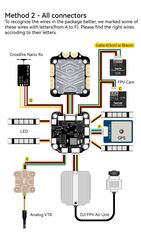
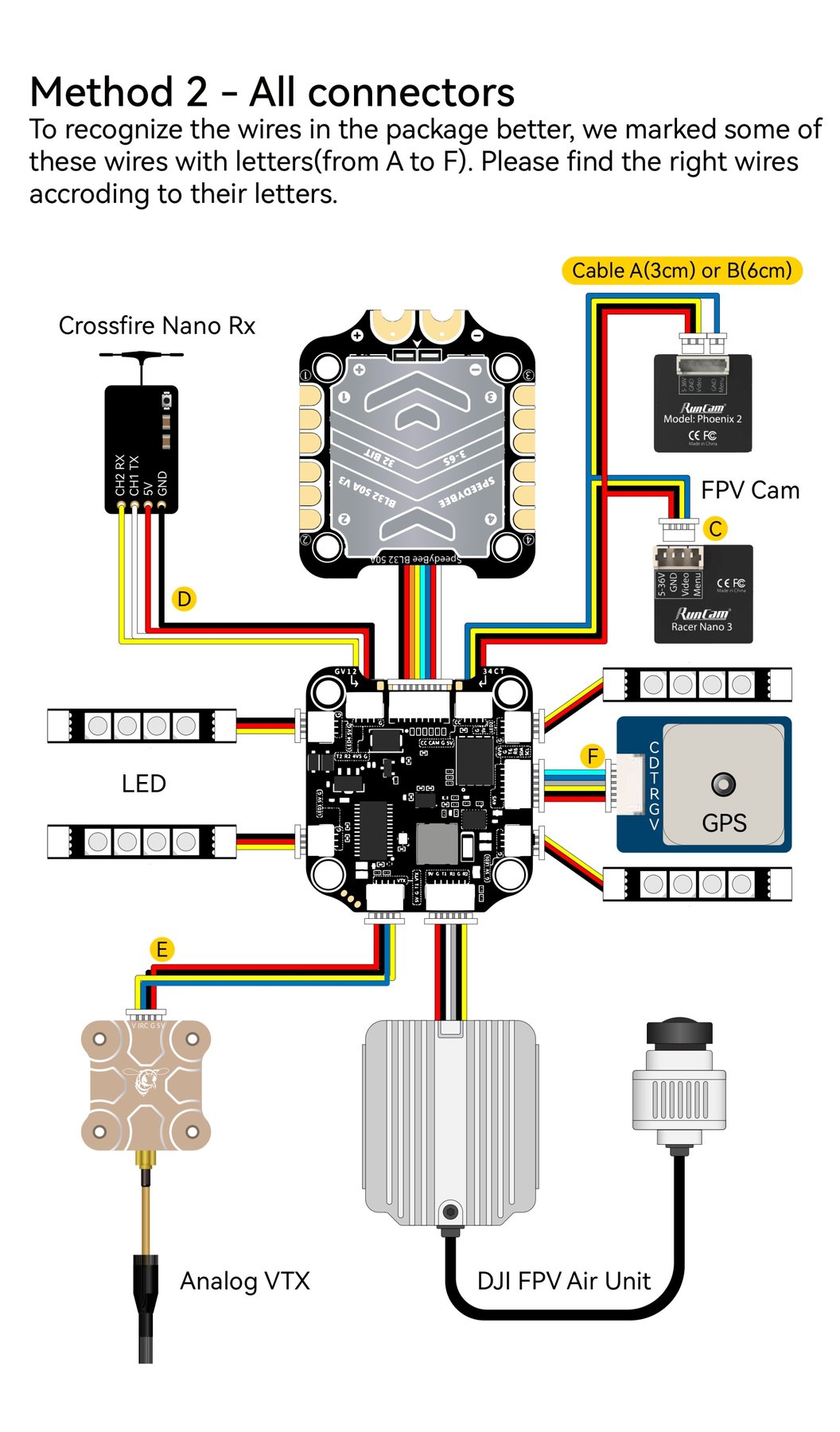 SpeedyBee F7 V3
The flight controller is a drone's compact control board: it reads the IMU and barometer, mixes the control commands and passes them to the ESCs. Typical boards run Betaflight, INAV or ArduPilot for FPV drones and small fixed-wing aircraft.
Dimensions (mm)
Dimensions of the module, carrier board or housing; for FPV boards also the mounting pattern. For modular autopilots include the baseboard.
Number of barometers
Number of air-pressure sensors for altitude measurement. A second barometer serves as a fallback.
Input voltage (V)
Permitted supply voltage, either regulated voltage from a power module or the battery voltage directly (in S). For boards powered directly from the battery, check the permitted cell count.
Supported firmware
Flight software that runs on the hardware, such as PX4, ArduPilot, Betaflight, INAV or manufacturer systems. The choice determines features, ground station and certification path; open firmware is widely documented.
Weight (g)
Mass of the part in grams as stated by the manufacturer. Check whether cables, mounts or accessories are included, as manufacturers report this differently.
Number of IMUs
Number of inertial measurement units (IMUs). Several IMUs allow plausibility checks and switch-over on sensor faults, which matters for professional operations.
IMU types
Sensor chips fitted, e.g. ICM-42688-P, BMI088 or ADIS16470. Different types in one unit reduce the risk that a common fault affects all IMUs at once.
NDAA compliant
Indicates whether the manufacturer explicitly declares compliance with US procurement rules (NDAA). The value is “ja” (yes) only where the manufacturer says so; empty means no statement found, not “no”.
Processor
Main processor of the flight controller, often an STM32 microcontroller (F4, F7, H7), on autopilots sometimes with an auxiliary I/O processor. Faster processors allow more elaborate filtering, more sensors and firmware such as PX4 or ArduPilot.
Interfaces
Connections for peripherals, such as UART, CAN, I2C, PWM outputs, Ethernet or telemetry ports. Enough free ports for GNSS, radio links, ESCs and payload avoid adapter solutions later.
Important are a mounting pattern and size that suit the frame, the number of UARTs for receiver, video link, GNSS and telemetry, and the supported firmware. H7 processors offer headroom for ArduPilot and elaborate filtering, while F4 and F7 boards are enough for many FPV uses. A built-in OSD overlays flight data on the analogue video image. The permitted input voltage must match the cell count if the board is powered directly from the battery. Boards listed as discontinued by the manufacturer are marked; successors were not always checked.
Some SpeedyBee boards are listed as discontinued by the manufacturer; successor models were not checked in every case.
Which firmware do I need for FPV racing?
Betaflight is common for FPV freestyle and racing; INAV or ArduPilot for GPS functions and fixed-wing aircraft.
What is an OSD?
An overlay of battery voltage, flight time and other values in the FPV goggles' video image.
Why does the number of UARTs matter?
Each serial add-on such as receiver, GNSS or video link occupies a UART; too few ports limit expansion.