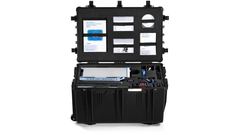
RF detectors for drone detection
Manufacturers in this group:
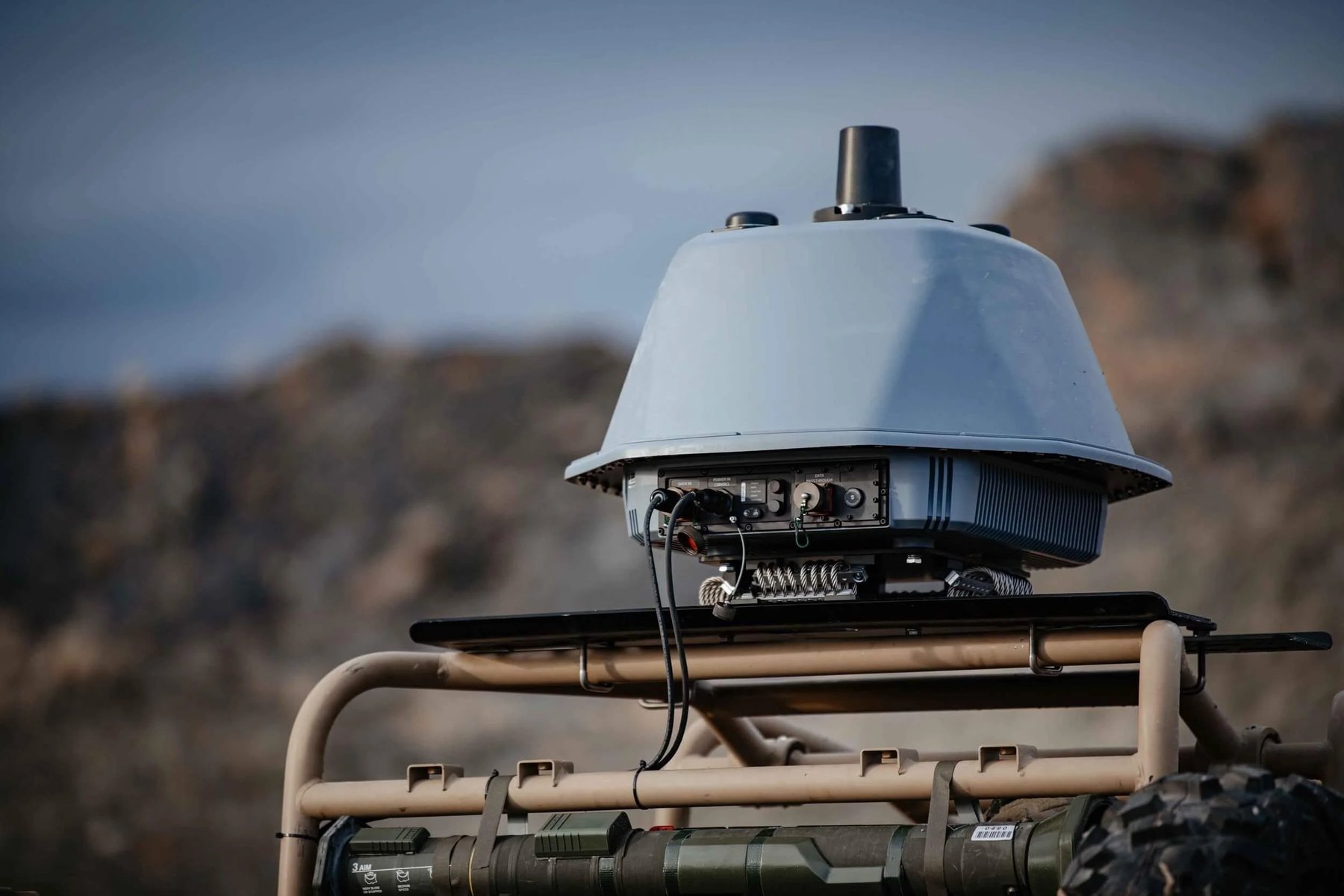 DroneShield RfPatrol Mk2
RF detectors passively receive the control, video and telemetry signals of drones and use them to identify the type and often the direction. Some units also decode Remote ID broadcasts and then show the pilot's position.
Coverage (degrees)
Horizontal detection or effect angle of a single unit. All-round protection needs either a 360-degree unit or several sector units.
Field of use
Fields of use named by the manufacturer, such as airport, prison, critical infrastructure, event, police or military. This is a manufacturer statement, not a permission to operate.
Detection range (km)
Distance up to which the detector picks up a drone's radio signals according to the manufacturer. Drones that do not transmit (autonomous or fibre-optic controlled) are fundamentally not detected by an RF detector.
Receiving range
Frequency range monitored by the passive detector. A wide range also covers control and video links outside the usual ISM bands.
Weight (kg)
Weight of the device or main unit in kilograms. For stationary installations usually without mast, power supply and control station.
Maximum targets
Number of targets the system can track simultaneously. Important for swarms or heavy nearby air traffic, for example at airports.
Mobility
Design: handheld, portable, vehicle-mounted, relocatable or stationary. It determines whether the system suits fixed sites or changing locations.
Sensor type
Type of detection or effect, such as radar, passive RF detector, camera or jammer. Combining several sensor types reduces false alarms and gaps.
Principle of effect
Describes in general terms how the system acts on a drone, for example radio jamming, protocol takeover or a capture net. For sensor-only systems it is empty or only describes detection.
Effect range (km)
Distance up to which the countermeasure works according to the manufacturer. Not given for sensor-only systems; manufacturer figures apply to favourable conditions.
Approval note
Short note from the data on approval and authorisation to operate, such as “authorities only” or “export licence required”. It does not replace a legal assessment of the individual case.
The receiving range should cover the bands of common drone radio systems; a wide range also catches unusual links. Units with direction finding show the bearing; several networked sensors give the position. Handheld units suit events and patrols, stationary ones prisons, airports and industrial sites. Detection range depends on transmit power and surroundings. RF detectors do not detect drones that do not transmit; these need radar or cameras.
RF detectors only detect transmitting drones; autonomous or fibre-optic controlled drones remain invisible.
The legal position on receiving and evaluating third-party radio signals (secrecy of communications, data protection) in Germany and Poland was not checked and must be clarified before use.
Ranges are manufacturer figures under favourable conditions and only partly comparable between manufacturers. No prices are available.
Does an RF detector transmit itself?
No, it only receives. It therefore does not interfere with other radio services.
Can an RF detector locate the pilot?
Some units show the pilot's position from Remote ID data or by direction finding on the remote control.
Why does an RF detector miss some drones?
Drones flying autonomously without a radio link or controlled via fibre optics transmit nothing it could receive.