Optical sensors for drone detection
Manufacturers in this group:
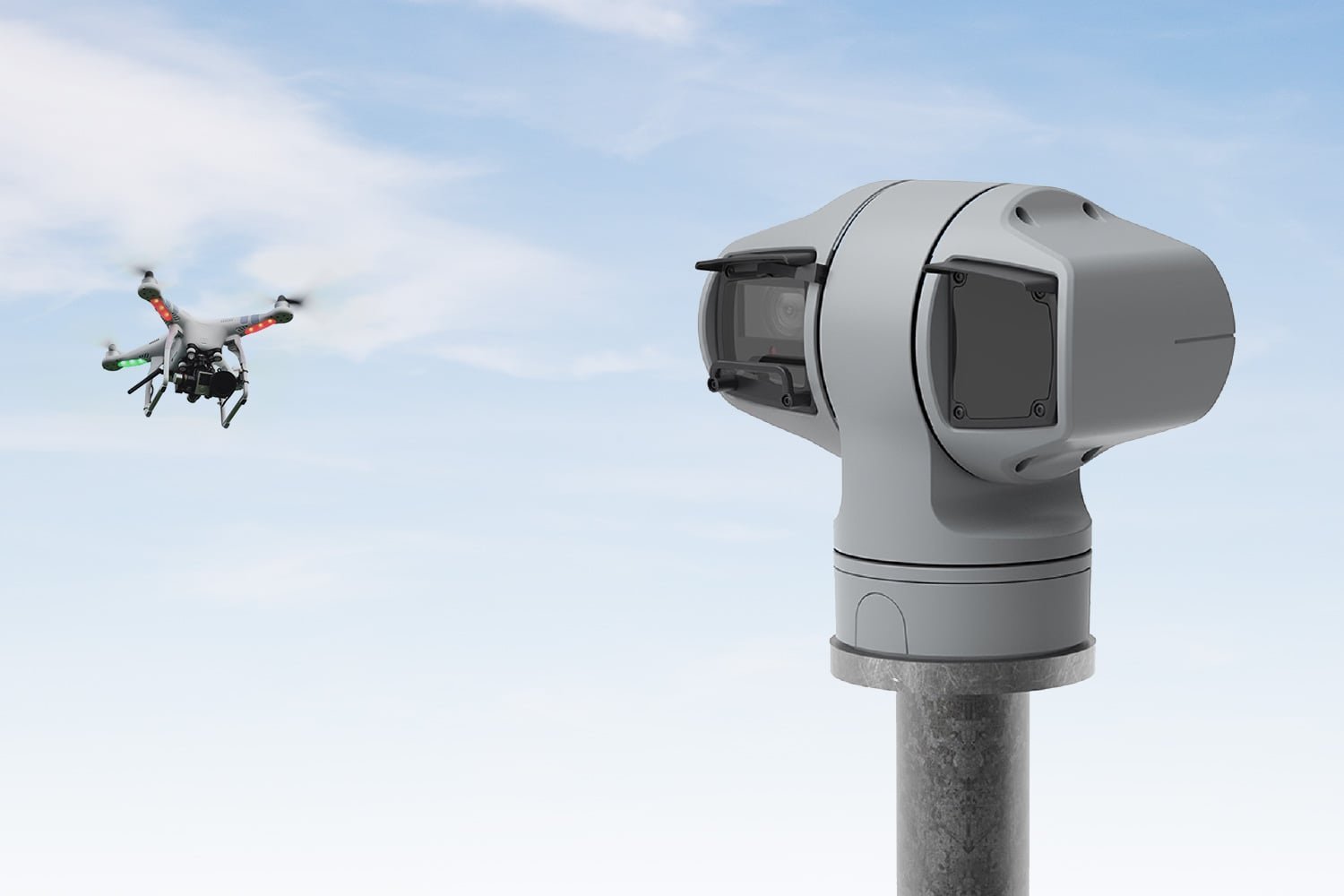 Dedrone (Axon) Dedrone PTZ-Kamera (Normalreichweite, Axis)
Optical sensors are pan-tilt daylight and thermal cameras that acquire and display a drone reported by radar or an RF detector. They serve mainly for confirmation and identification, for example whether a payload is carried.
Coverage (degrees)
Horizontal detection or effect angle of a single unit. All-round protection needs either a 360-degree unit or several sector units.
Field of use
Fields of use named by the manufacturer, such as airport, prison, critical infrastructure, event, police or military. This is a manufacturer statement, not a permission to operate.
Detection range (km)
Distance up to which the camera shows a drone according to the manufacturer. It depends on weather, light and drone size; detection, classification and identification succeed at different distances.
Frequency bands
Radio ranges the device receives or occupies, such as ISM bands or GNSS. For detection-only devices it is the receiving range.
Weight (kg)
Weight of the device or main unit in kilograms. For stationary installations usually without mast, power supply and control station.
Mobility
Design: handheld, portable, vehicle-mounted, relocatable or stationary. It determines whether the system suits fixed sites or changing locations.
Sensor type
Type of detection or effect, such as radar, passive RF detector, camera or jammer. Combining several sensor types reduces false alarms and gaps.
Principle of effect
Describes in general terms how the system acts on a drone, for example radio jamming, protocol takeover or a capture net. For sensor-only systems it is empty or only describes detection.
Effect range (km)
Distance up to which the countermeasure works according to the manufacturer. Not given for sensor-only systems; manufacturer figures apply to favourable conditions.
Approval note
Short note from the data on approval and authorisation to operate, such as “authorities only” or “export licence required”. It does not replace a legal assessment of the individual case.
Important are optical zoom, a thermal channel for night and poor visibility, and a fast pan-tilt mechanism. Detection range depends on weather, light and drone size; detection succeeds at greater distances than identification. Cameras are usually coupled with radar or RF detectors that cue the target. Fixed sites typically use stationary units, changing locations relocatable ones. So far only a few optical systems are recorded in the data.
Recording people and property is subject to data protection law; take this into account when installing.
Ranges are manufacturer figures under favourable conditions and only partly comparable between manufacturers. No prices are available.
The optical category has few entries; the selection is not representative.
Why are cameras needed in addition to radar?
Radar reports a target; the camera confirms whether it is a drone and what it carries.
Does detection work at night?
With a thermal channel or infrared illumination yes; with a daylight camera only to a limited extent.
What is the difference between detection and identification?
Detection means noticing an object; identification means reliably determining type and features, which requires a shorter distance.

