Vergauwe Other models
1 model in this series
Vergauwe VF 35BE: single-axle EU class O3 trailer with a 4,800 kg gross weight, 2,106 kg unladen weight and a 90 km/h design top speed for medium-sized machinery
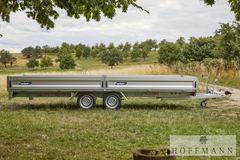
With a gross vehicle weight of 4,800 kg, this trailer from Vergauwe falls into EU trailer class O3, the band between 3.5 and 10 tonnes that usually requires an air brake system. Registration requires a number plate and a recurring technical inspection of the chassis, axles and braking system.
Read on 3 more paragraphs
The VF 35BE has an unladen weight of 2,106 kg, giving a payload of around 2,694 kg. At a length of 5,850 mm and a width of 2,200 mm, this is a compact, single-axle build. Its design top speed of 90 km/h is lower than the usual 100 km/h, as is common with higher axle loads. The single axle must absorb the entire load on its own, which calls for robust axle stubs and correspondingly rated suspension.
Single-axle trailers at the lower end of class O3 already carry noticeably more than ordinary car trailers while staying more compact than multi-axle low-loaders. They suit medium-sized machinery and equipment. Depending on the combination's permitted gross weight, the towing vehicle requires driving licence category BE or C1E. Spare parts for brake drums or discs, suspension components and lighting are available through the general parts trade for this vehicle class, independent of the original manufacturer.
When buying used, the single axle with its suspension and wheel bearings needs particular attention, since it alone carries the entire load. The air brake system with its lines, valves and brake cylinders, tyre condition, and the chassis around the axle mount belong on the checklist.
Sources: SpecCodex-Register: Kennwerte des Modells Vergauwe VF 35BE
Models
Trailer in 3D section
Turn the model, look inside and click an assembly — each one is explained.
