Vangs Other models
4 models in this series
Vangs 1980 VANG SHSL: heavy EU class O4 trailer with a 50,000 kg gross weight, 12,800 mm length and around 42,900 kg payload for steel and building-material transport

With a gross vehicle weight of 50,000 kg, this trailer from Vangs falls into EU trailer class O4, the band of heavy trailers and semi-trailers above 10 tonnes.
Read on 3 more paragraphs
It has an unladen weight of 7,100 kg, giving a payload of around 42,900 kg. At a length of 12,800 mm and a width of 2,550 mm, the deck footprint stays within the dimensions permitted without a special permit, while the ratio of tare to payload points to a pure load-carrying platform. The straightforward ratio of tare weight to payload matches that of a simple, load-bearing deck without additional bodywork.
Heavy trailers of this kind are used to move building materials, steel and machinery, where compact, dense cargo takes up most of the gross weight allowance. The towing vehicle requires driving licence category CE, and the standard air brake acts on every axle, checked independently at each roadworthiness inspection. Spare parts for brake drums or discs, suspension components and lighting are available through the general parts trade for this vehicle class, independent of the original manufacturer.
When buying used, the checklist should include the chassis and main beams around the axle mounts, where sustained loading leaves cracks and corrosion at welds. Brake pads, drums or discs and the air-line hoses should be checked along with tyre condition and play in the axle bearings, which can indicate past overloading. The air-line connector heads, the load-sensing brake valve and the suspension on every axle also belong on the pre-purchase checklist.
Sources: SpecCodex-Register: Kennwerte des Modells Vangs 1980 VANG SHSL
Models
Trailer in 3D section
Turn the model, look inside and click an assembly — each one is explained.
1980 VANG SHSL
The Vangs 1980 VANG SHSL is a vehicle built by Vangs. Production: 1997. The vehicle is 12,800 mm long and 2,550 mm...
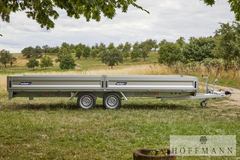
ATH
The ATH comes from Vangs. Production: 2014. The vehicle is 20,777 mm long and 2,550 mm wide. The unladen weight is...
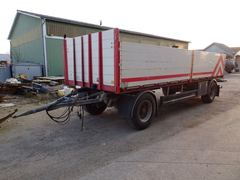
ATHLS 111+1
The Vangs ATHLS 111+1 is a vehicle built by Vangs. Production: 2014. The vehicle is 21,047 mm long and 3,100 mm...
VangsATHLS 111+1+1no photoATHLS 111+1+1
The ATHLS 111+1+1 comes from Vangs. Production: 1999. The vehicle is 20,348 mm long and 2,570 mm wide. The unladen...
