Reycar Other models
1 model in this series
Reycar SEM7000/2: EU class O3 trailer with a gross weight of 4,000 kg, a length of 7,250 mm and a wheelbase of 5,400 mm, built in 2003
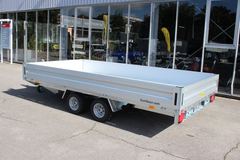
With a gross weight of 4,000 kg, the Reycar SEM7000/2 falls into EU trailer class O3, covering the range from 3,500 kg to 10 tonnes. Trailers in this class sit right at the threshold for compressed-air brakes and are used both in commercial transport and in agricultural or trade work with medium-weight towing vehicles. They carry general cargo, machinery or building materials in a weight range that calls for larger towing vehicles than the light O2 trailers.
Read on 3 more paragraphs
At a length of 7,250 mm and a width of 2,330 mm, the SEM7000/2 is a narrower, medium-length trailer. An unladen weight of 1,620 kg allows a payload of around 2,380 kg, more than half of the gross weight. The 5,400 mm wheelbase is large relative to the overall length and points to a chassis with widely spaced axles, which helps stability under load. The 2003 build year places the trailer before today's trailer brake regulations.
In class O3, depending on the exact gross weight, a trailer's own service brake compatible with the towing vehicle is required. A combination with a trailer of this weight usually needs a category BE or C1E licence, depending on the gross weight of the combination. The long wheelbase relative to the load area benefits tracking stability when reversing, but needs more manoeuvring space than short trailers.
When buying a trailer from 2003 second-hand, the brake system belongs on a test bench, particularly the brake lines and the overrun brake mechanism if the trailer has no compressed-air brakes. The condition of the frame at the axle mounts and the state of the leaf springs show how often the trailer ran close to its payload limit. Spare parts for axles, brakes and lighting are usually easy to source in this common weight class.
Sources: SpecCodex-Register: Kennwerte des Modells Reycar SEM7000/2
Models
Trailer in 3D section
Turn the model, look inside and click an assembly — each one is explained.
