Oliver Hart Parr 70-SERIE
1 model in this series
Oliver Hart Parr 70 HC/KD (1935-1937): six-cylinder farm tractor with a petrol-and-kerosene carburettor engine, 18.8 kW output and a top speed of 9.5 km/h from the 70-Series
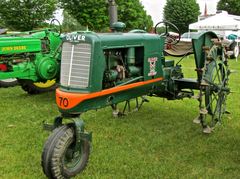
Hart-Parr was one of the pioneers of American tractor building and was absorbed into the Oliver brand, under which the vehicles were sold as Oliver Hart-Parr from the mid-1930s onward. The 70 HC/KD from the 70-Series was built between 1935 and 1937 and belonged to the mid-range standard tractors of this transitional period.
Read on 3 more paragraphs
The six-cylinder engine, with a displacement of 3,300 cm³, is designed to run on petrol or kerosene, as was common for American tractors of this era: started on petrol and often switched to the cheaper kerosene once working in the field. At 1,500 rpm the engine delivers 18.8 kW, equivalent to 25.5 horsepower. With a weight of 1,588 kg, a wheelbase of 1,829 mm and a top speed of 9.5 km/h, the tractor was built for drawbar work rather than road travel.
Carburettor engines running on petrol and kerosene characterised American tractors of the 1920s and 1930s, before the diesel engine took over; their advantage was the lower price of kerosene, their drawback lower efficiency and higher consumption. The water cooling system required regular checking of the coolant level in the field, especially under full load during ploughing.
When buying a used Oliver Hart-Parr of this series, the condition of the carburettor and the petrol-to-kerosene switching mechanism is decisive, since these parts are missing or rebuilt on many surviving examples. The radiator and cylinder head gasket also deserve attention, as does the condition of the narrow tyres, which are rarely original on museum vehicles.
Sources: SpecCodex-Register: Kennwerte des Modells 70 HC/KD
Models
Tractor in 3D section
Turn the model, look inside and click an assembly — each one is explained.
