Niva Other models
2 models in this series
Lada Niva – collective page of off-roaders outside the named series: factory code VAZ-2121, four-wheel drive, 47 kW, 1,570 to 1,710 cc, kerb weight 1,200 to 1,220 kg
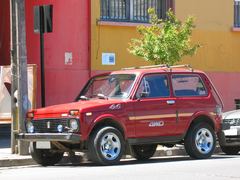
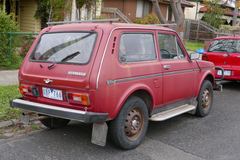
This collective page lists Lada Niva versions the register has not assigned to a named series. The Russian maker AvtoVAZ has built the Niva since 1977 at its Tolyatti plant as a permanent four-wheel-drive off-roader; the factory code VAZ-2121 in the designation 2DSEDAN 1600VAZ-2121-4X4/2200 identifies the series, 4X4 marks the four-wheel drive, and the number 1600 the engine displacement in cubic centimetres.
Read on 4 more paragraphs
The register lists here 2 versions rated at 47 kW from a four-cylinder engine of 1,570 to 1,710 cc, kerb weights from 1,200 to 1,220 kg, a gross weight of 1,550 kg and widths from 1,680 to 1,820 mm.
The Niva is regarded as one of the first mass-produced compact off-roaders with unitary body construction, and found demand worldwide chiefly for its low price and simple mechanicals, from farm use to private off-road driving across eastern and western Europe.
The Niva's four-wheel drive is permanent and can be reinforced further through a lockable centre differential, rather than switching between rear-wheel and four-wheel drive as on many rivals; combined with its unitary body, this was an unusual pairing for an off-roader of its time.
When buying used, check for rust on wheel arches, sills and the floorpan, the condition of the transfer case and differentials, carburettor or early fuel-injection technology, the brakes and the tightness of the simple body; parts are widely available through the Lada parts trade and independent workshops.
Sources: SpecCodex register, model data: Lada Niva
Models
Van in 3D section
Turn the model, look inside and click an assembly — each one is explained.