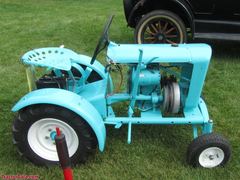
Maschinenbau Ernst Wanner Wangen / Allgäu Fix
2 models in this series
Wanner Kleinschlepper Fix: single-cylinder two-stroke engine on an oil-petrol mix, 300 cc, rated at 6.5 hp (4.9 kW) at 3,000 rpm, a tiny post-war tractor for smallholdings, 1949 to 1951
In the years immediately after the Second World War, a great number of small workshops and machine shops sprang up across Germany, building simple, cheap small tractors for farmers who could not afford a full-sized one. The Fix, built between 1949 and 1951, belongs to this wave of early mechanisation on smallholdings.
Read on 3 more paragraphs
The Fix is driven by a fan-cooled single-cylinder engine of 300 cc displacement, running on an oil-petrol mixture at a ratio of 1:20 to 1:25 and rated at 6.5 hp (4.9 kW) at 3,000 rpm. Unladen weight is only 420 kg, at a width of 1,450 mm, length of 2,000 mm and height of 1,350 mm. Top speed is 20 km/h.
Running on an oil-petrol mixture indicates a two-stroke engine, common in simple small units of the period for cost reasons. At just 6.5 hp and 420 kg, the Fix belongs to the smallest class of agricultural tractors, sufficient for light drawbar and drive work on very small plots where larger, more expensive machines were not economically viable.
On a surviving example of such a small tractor, check the two-stroke engine for correct mixture ratio and piston wear, the fan for proper operation, since cooling without water depends entirely on airflow, and the simple chassis for cracking at the welds. Parts for such rare small tractors can practically only be obtained from collectors or as custom-made reproductions.
Sources: SpecCodex-Register: Kennwerte des Modells Maschinenbau Ernst Wanner Kleinschlepper (Fix)
Models
Tractor in 3D section
Turn the model, look inside and click an assembly — each one is explained.