Leyland Other models
6 models in this series
Leyland Tiger (PS) – a British chassis for coach and service-bus bodies: diesel engines from 7.4 to 9.8 litres, a four-speed manual or Pneumocyclic semi-automatic, lengths from 8.5 to 11 m
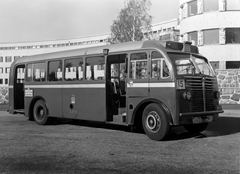
Leyland Motors was one of Britain's most important bus and truck makers, with works at Farington near Preston in Lancashire. The Tiger (PS) was a chassis range for coach and service-bus bodies from independent body builders, sold in large numbers at home and abroad.
Read on 3 more paragraphs
Depending on the version, Leyland fitted the Tiger (PS) with the 7.4-litre six-cylinder E181, the 8.6-litre E87, or the 9.8-litre O600, all upright diesel engines. Buyers could choose between a classic four-speed manual gearbox or Leyland's own semi-automatic Pneumocyclic transmission with four or five speeds. Depending on the body, the chassis measured between 8.5 and 11 m in length.
As a bare chassis with no fixed body, the Tiger (PS) gave body builders great freedom over door layout, seating capacity and interior fitout, so it was put into service both as a coach with generous luggage space and as a long-distance service bus. The semi-automatic Pneumocyclic transmission was a technical hallmark that set Leyland apart from many competitors of its day.
For a preserved Tiger (PS), check the condition of the fitted diesel engine at the cylinder liners and injection pump, the operation of the manual gearbox or the Pneumocyclic transmission, and corrosion on the chassis frame and on the individual bodywork of the respective builder. Since body and chassis came from different firms, parts supply depends heavily on the particular body builder and today runs mainly through British heritage-bus specialists.
Sources: SpecCodex-Register: Kennwerte des Modells Leyland Tiger (PS)
Models
Bus in 3D section
Turn the model, look inside and click an assembly — each one is explained.
Leyland Tiger (PS)
The Leyland Motors Leyland Tiger (PS) is a bus made by Leyland Motors. Power is transmitted through a (PS1/OPS1)...
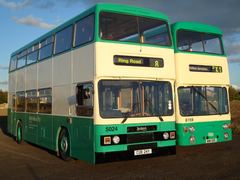
AXJ 857
The AXJ 857 comes from Leyland. Production: 1934. The engine comes from Leyland. The engine is water-cooled. The...
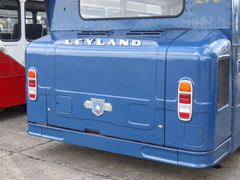
Leyland Lion (PSR1)
The Leyland Motors Leyland Lion (PSR1) is a bus from Leyland Motors. Power is transmitted through a Leyland...
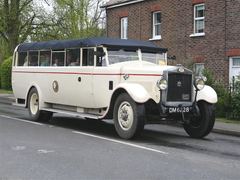
Lioness
The Leyland Lioness rolled off the line in 1927 as a bus. It combines a manual gearbox with 4x2.
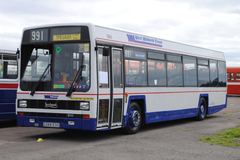
Lynx
The Leyland Lynx is a bus from Leyland. Gearbox: Leyland Hydracyclic semi-automaticZF Ecomat automatic. Overall...
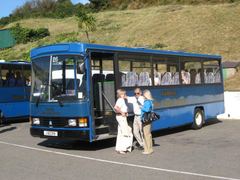
Swift
The Leyland Swift is a bus made by Leyland.
