Hsu Other models
2 models in this series
Hsu P54-3 – EU class O3 trailer: 5,500 kg gross vehicle weight, 3,990 kg payload, 9.65 m length, 7.00 m wheelbase, built in 2023.
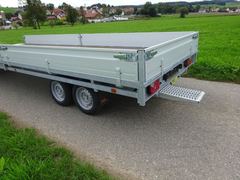
With a gross weight of 5,500 kg, the Hsu P54-3 falls into EU trailer class O3, covering trailers between 3.5 and 10 tonnes gross weight. Vehicles in this class sit between light car trailers and the heavy semi-trailers of long-distance haulage, and mostly run behind trucks or powerful tractors. They often carry building materials, agricultural equipment or palletised goods, loads for which a single car trailer would be too small and a semi-trailer too large.
Read on 3 more paragraphs
With an unladen weight of 1,510 kg, payload comes to 3,990 kg. At 9.65 m long, 2.55 m wide, on six wheels and with a 7.00 m wheelbase, the trailer sits on a long, multi-axle chassis that spreads the gross weight across several axles.
Trailers of this size sit at the boundary between overrun brakes and air brake systems; both are found in practice at this weight range. Towing requires at least licence category BE, and behind a category C1 or C truck the combination is driven under C1E or CE. The exact type of brake system fitted also determines which inspection intervals and testing obligations apply to the trailer.
With this multi-axle design, it is worth checking the wheel hubs and brake drums of each axle individually when buying: uneven wear between axles points to a faulty load-equalising mechanism. Check the air-spring bellows or leaf springs for cracks, check the brake lines for chafing, and check the underrun guard and side marker lights for completeness. Check the tyres on all axles for matching tread and age, since mismatched tyres change the load distribution.
Sources: SpecCodex-Register: Kennwerte des Modells Hsu P54-3, Zulassungsdaten RDW (Niederlande)
Models
Trailer in 3D section
Turn the model, look inside and click an assembly — each one is explained.
