Egyedi Other models
4 models in this series
Egyedi – other models: the collective page of Hungarian custom builds outside the named ranges, RF and AF type codes referencing gross weight, unladen weights from 860 to 7,980 kg, gross weights from 2,500 to 34,000 kg
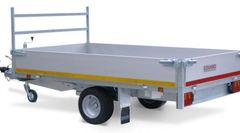
Egyedi is Hungarian for a custom or individual build, and in the register it does not stand for a single factory but for a collective category of individually built or converted trailers that could not be assigned to a named range of any manufacturer. Type codes such as 2RF 2500, 3RF-3500 and 3AF-34000 give the gross weight in kilograms in the latter part of the designation.
Read on 3 more paragraphs
The register lists here 4 versions with unladen weights from 860 to 7,980 kg, gross weights from 2,500 to 34,000 kg, lengths from 9,900 to 13,560 mm and widths from 2,100 to 2,550 mm.
The span from 2.5 to 34 tonnes gross weight shows that this collective category covers both light custom builds of class O2 and self-built or converted heavy-duty trailers of class O4 – typical of trailers built by hand rather than in series production. Such individually registered trailers are common wherever a workshop converts or builds a chassis for a specific job rather than buying a series model.
On used custom builds, checking the type approval or individual inspection certificate, the condition of welds and load-bearing parts, the axle and brake system and the overrun brake all matter in particular; since every version is a one-off, it is worth comparing the actual construction with the values entered in the vehicle papers. Tyres, lighting and the coupling should also be checked closely on a custom build, since no series standard applies.
Sources: SpecCodex register, model data: Egyedi (weitere Modelle)
Models
Trailer in 3D section
Turn the model, look inside and click an assembly — each one is explained.
3AF-34000
The Egyedi 3AF-34000 is a vehicle built by Egyedi. Production: 1993. The vehicle is 13,560 mm long and 2,550 mm...
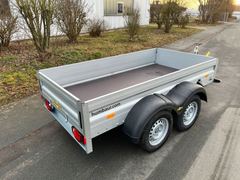
2RF 2500
Egyedi builds the 2RF 2500. According to the available register data, the vehicle dates from 2003. Dimensions: 2,230...
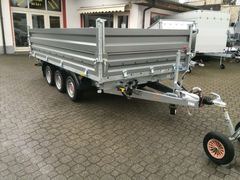
3RF-3500
The 3RF-3500 comes from Egyedi. Production: 2013. The vehicle is 9,900 mm long and 2,100 mm wide. The unladen weight...
Egyedi3�F-34000no photo3�F-34000
3�F-34000 comes from the manufacturer Egyedi. According to the available register data, the vehicle dates from 1993....
