Daimler Benz Unimog
8 models in this series
Unimog 401 (1953–1956): Daimler-Benz Unimog model designation with the OM 636 diesel, 1,767 cm³ and 18.5 kW, after Boehringer's series start in Göppingen
The Unimog traces back to a first prototype built in 1946 by Erhard und Söhne in Schwäbisch Gmünd. Series production began at Boehringer in Göppingen, where about 600 examples of the U 70200 type were built by 1951; in autumn 1950 Boehringer sold this business to Daimler-Benz, which took over production at its Gaggenau plant in 1951, initially under the designation 2010. Daimler-Benz used the model designation 401 from 1953 to 1956.
Read on 3 more paragraphs
The Unimog 401 carries the OM 636 diesel engine with 1,767 cm³ of displacement, producing 18.5 kW, paired with a six-speed manual gearbox with two reverse gears. At 2,050 mm high, 3,520 mm long and 1,630 mm wide, the machine is compact enough for field tracks and narrow yard access.
The OM 636 engine came from Daimler-Benz's car and light commercial vehicle production, making it a unit from another vehicle segment that gave the Unimog its unusually refined running behaviour for a tractor. Four-wheel drive, portal axles and the high ground clearance of the Unimog concept allowed work off-road just as well as on paved roads, where the six-speed gearbox gave a travel speed unusually high for a farm tractor of the period.
When buying an early Unimog 401 used, authenticity and provenance matter most, as few examples survive from this early phase of Unimog production. The condition of the cooling system and the injection pump of the OM 636 should be checked, along with the tightness of the portal axles and any rebuilds or repairs, often carried out over the decades on such rare early vehicles.
Sources: SpecCodex-Register: Kennwerte des Modells Unimog 401
Models
Tractor in 3D section
Turn the model, look inside and click an assembly — each one is explained.
Unimog 401
The Unimog 401 from Daimler Benz is part of the Unimog series. The engine delivers 18.5 kW. The machine is 3,520 mm...
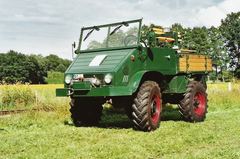
Unimog 411
The Daimler Benz Unimog 411 is a tractor made by Daimler Benz. Engine output is 18.5 kW. The powerplant was supplied...
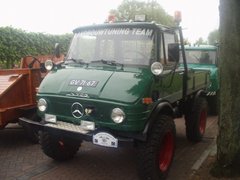
Unimog 421
The Daimler Benz Unimog 421 is a tractor from the Unimog series. Gearbox: Manual gearbox and 2×4 gears.

Unimog 425
The Daimler Benz Unimog 425 is a tractor from the Unimog series. 88 kW is available. The powerplant was supplied by...
Daimler BenzUnimog 2010no photoUnimog 2010
The Daimler Benz Unimog 2010 is a tractor from the Unimog series. The engine is rated at 18.5 kW. Power is...
Daimler BenzUnimog 409no photoUnimog 409
The Daimler Benz Unimog 409 is a tractor from the Unimog series. On the road, up to 65 km/h is possible. Width is 1.60 m.
Daimler BenzUnimog 424no photoUnimog 424
The Daimler Benz Unimog 424 is a tractor made by Daimler Benz. Top speed is 80 km/h.
Daimler BenzUnimog 427no photoUnimog 427
The Daimler Benz Unimog 427 is a tractor made by Daimler Benz.
