Daedong John Deere Other models
4 models in this series
Daedong John Deere – other models: the collective page of Deere tractors built under licence in South Korea outside the named ranges, 5720 to 6630 Premium, 60 to 93 kW (80 to 125 hp), diesel engines
This page gathers the tractors the South Korean maker Daedong built under licence under the John Deere name, which the register could not assign to a named range. The models carry regular John Deere designations from the 5000 and 6000 series, the Premium suffix marking the higher equipment line.
Read on 4 more paragraphs
The register lists here 4 versions, all with a diesel engine, with 60 to 93 kW, or 80 to 125 hp.
Licence-built tractors of this kind mainly supplied the South Korean and South-East Asian market with mid-range farm tractors, rounding out Deere's global programme where local production saved on tariffs and logistics costs.
Buyers of used units should check the engine and injection system for operating hours, as well as the gearbox, clutch and hydraulic pump and the cab seals and electrics for moisture damage; since these versions did not run through every Deere distribution network, it is worth checking before buying whether spares run through the regular Deere trade or only through specialist importers. Since bodywork parts and decals can differ by market, comparing with original photos or brochures helps place the particular version.
With rated outputs from 60 to 93 kW, these models fall within ISO 730 Category II for the rear three-point hitch, with a standard dual-speed power take-off at 540 and 1,000 revolutions per minute; John Deere remains an active engine and tractor manufacturer, although the licence-built Daedong versions can include technically distinct components.
Sources: SpecCodex register, model data: Daedong John Deere – weitere Modelle
Models
Tractor in 3D section
Turn the model, look inside and click an assembly — each one is explained.
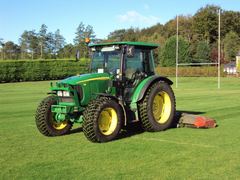
5720
The Daedong John Deere 5720 is a machine built by Daedong John Deere. The engine delivers 80 hp (60 kW). The engine...

6430 Premium
The 6430 Premium comes from Daedong John Deere. The engine delivers 115 hp (86 kW). The engine is water-cooled. The...

6620
The Daedong John Deere 6620 is a machine built by Daedong John Deere. The engine delivers 125 hp (93 kW). The engine...

6630 Premium
The 6630 Premium comes from Daedong John Deere. The engine delivers 125 hp (93 kW). The engine is water-cooled. The...
