BUECKER Other models
4 models in this series
Bücker – other models: the collective page of trailers outside the named ranges, listed in the register as Bücker Trailer GmbH, 940 to 1,230 kg unladen weight, 2,400 to 3,000 kg gross weight, 4,720 to 5,550 mm length
This page gathers the trailers the register could not assign to a named range and lists under the short name Bücker; one of the model entries gives the full company name Bücker Trailer GmbH. Two further entries are recorded as N.V.T and N/A with no type name of their own. As with many smaller trailer brands, the programme is drawn from registration data, in which each model is listed individually with its technical values.
Read on 3 more paragraphs
The register lists here 4 versions with unladen weights from 940 to 1,230 kg, gross weights from 2,400 to 3,000 kg, lengths from 4,720 to 5,550 mm and widths from 2,250 to 2,520 mm.
With gross weights of up to three tonnes against a comparatively moderate unladen weight, the payload reserve reaches over half the gross weight – a layout typical of car, boat or machinery transport trailers behind suitably rated tow vehicles. For registration behind a car, besides the trailer's gross weight the tow vehicle's rated towing capacity is also decisive, since it sets the real limit for the load towed.
On a used example, the condition of axles and brakes, rust on frame and load bed, the function of ramps or a winch on transport trailers, lighting and plug, and tyres and rims all count; the actual load should be checked against the gross weight before purchase. Parts for such small brands usually run through independent trailer workshops. On versions with an overrun brake, the adjustment of the brake linkage and the condition of the brake linings are also worth checking before the first drive.
Sources: SpecCodex register, model data: Bücker (weitere Modelle)
Models
Trailer in 3D section
Turn the model, look inside and click an assembly — each one is explained.
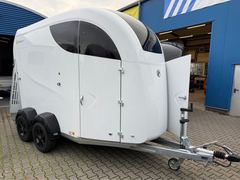
BUCKER
BUCKER comes from the manufacturer BUECKER. According to the available register data, the vehicle dates from 2022....

BUCKER TRAILER GMBH
BUECKER builds the BUCKER TRAILER GMBH. According to the available register data, the vehicle dates from 2026....

N.V.T
BUECKER builds the N.V.T. According to the available register data, the vehicle dates from 2018. Dimensions: 2,370...

N/A
The manufacturer of this trailer is BUECKER. According to the available register data, the recorded vehicles date...
