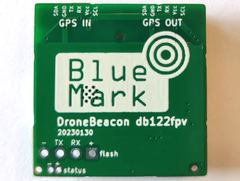
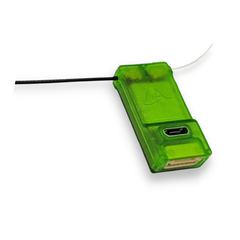
Remote ID modules for drones
Manufacturers in this group:
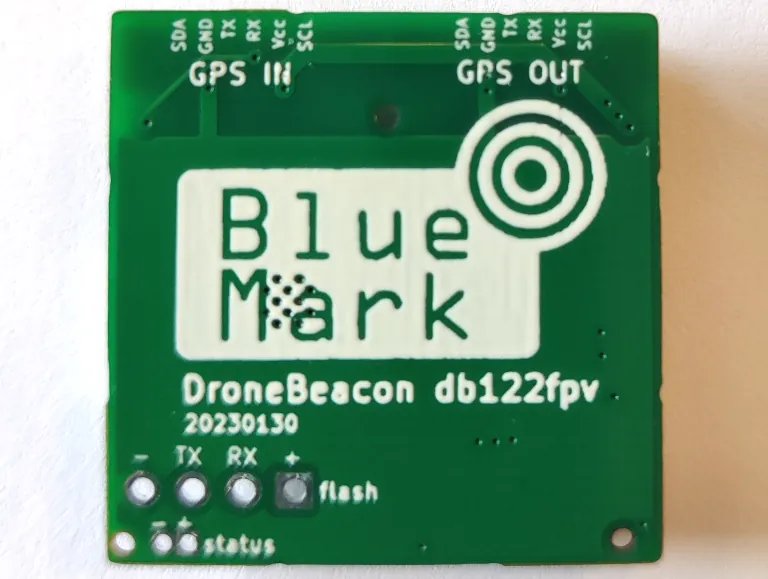 BlueMark Innovations DroneBeacon db120
Remote ID modules broadcast an identification of the drone with position and operator data during flight, which can be received on site, for example with a smartphone. They come as stand-alone add-on modules and as modules for installation in flight controllers.
Battery life (h)
Operating time of stand-alone modules with their own battery. It should cover several flights, as the module must transmit throughout the flight.
Type
“standalone” is a self-contained add-on module with its own power supply; “broadcast_modul_integriert” is a module for installation that is connected to the drone's flight controller or power supply.
Radio technology
How the identification is transmitted: directly via Bluetooth or Wi-Fi (broadcast, beacon, NAN), on some devices also via mobile network (network remote ID). Direct broadcast is the form that can be received on site with smartphones.
Weight (g)
Weight of the module. On small drones every gram counts, because an add-on changes the take-off mass and in some cases the classification.
Built-in GNSS receiver
True when the module determines its own position. Without its own receiver it needs position data from the flight controller.
Standard
Technical standard the device transmits to: ASD-STAN EN 4709-002 in the EU, ASTM F3411 in the USA. For use in the EU the European standard must be stated; Aerobits lists “F3211-19”, probably a typo for ASTM F3411-19.
Certification
Approvals and declarations stated, such as FAA acceptance, EU declaration of conformity or CE. “CE ausstehend” (CE pending) means it is not yet documented for the EU market.
For use in the EU the module must transmit according to ASD-STAN EN 4709-002 and carry an EU declaration of conformity; US standards alone are not enough. Stand-alone modules with their own battery and GNSS can be fitted to any drone but need enough runtime for several flights. Built-in modules are lighter and use the flight controller's power and position. On small drones the module's weight counts towards take-off mass. Check that the operator registration number can be entered.
EU: requirements for direct remote identification add-ons are set out in Part 6 of the Annex to Delegated Regulation (EU) 2019/945, inserted by Delegated Regulation (EU) 2020/1058. Among other things, the module must accept the operator registration number and broadcast, throughout the flight, the serial number, time, position and height, course and speed, and the position of the pilot or the take-off point.
According to a ULC notice (as reported by dlapilota.pl), direct remote identification must be active on drones of classes C1, C2, C3, C5 and C6; exemptions include C0, C4, tethered drones and drones without a class placed on the market before 01.01.2024. In the specific category the obligation has applied since 01.01.2024.
Aerobits cites the standard “F3211-19”, probably a typo for ASTM F3411-19; clarify before publication.
Which drones need Remote ID in the EU?
According to the ULC notice, drones of classes C1, C2, C3, C5 and C6 and flights in the specific category; exemptions apply to C0 and C4, among others.
Is a module with FAA acceptance enough in Europe?
Not automatically. In the EU, conformity with European rules counts, usually with the ASD-STAN EN 4709-002 standard.
What does a Remote ID module transmit?
According to Part 6 of Regulation (EU) 2019/945, among other things the operator number, serial number, time, position, height, course, speed and the position of the pilot or take-off point.