Battery cells for drone packs
Manufacturers in this group:
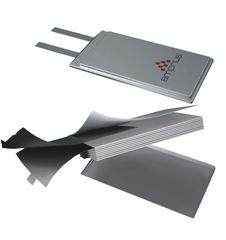
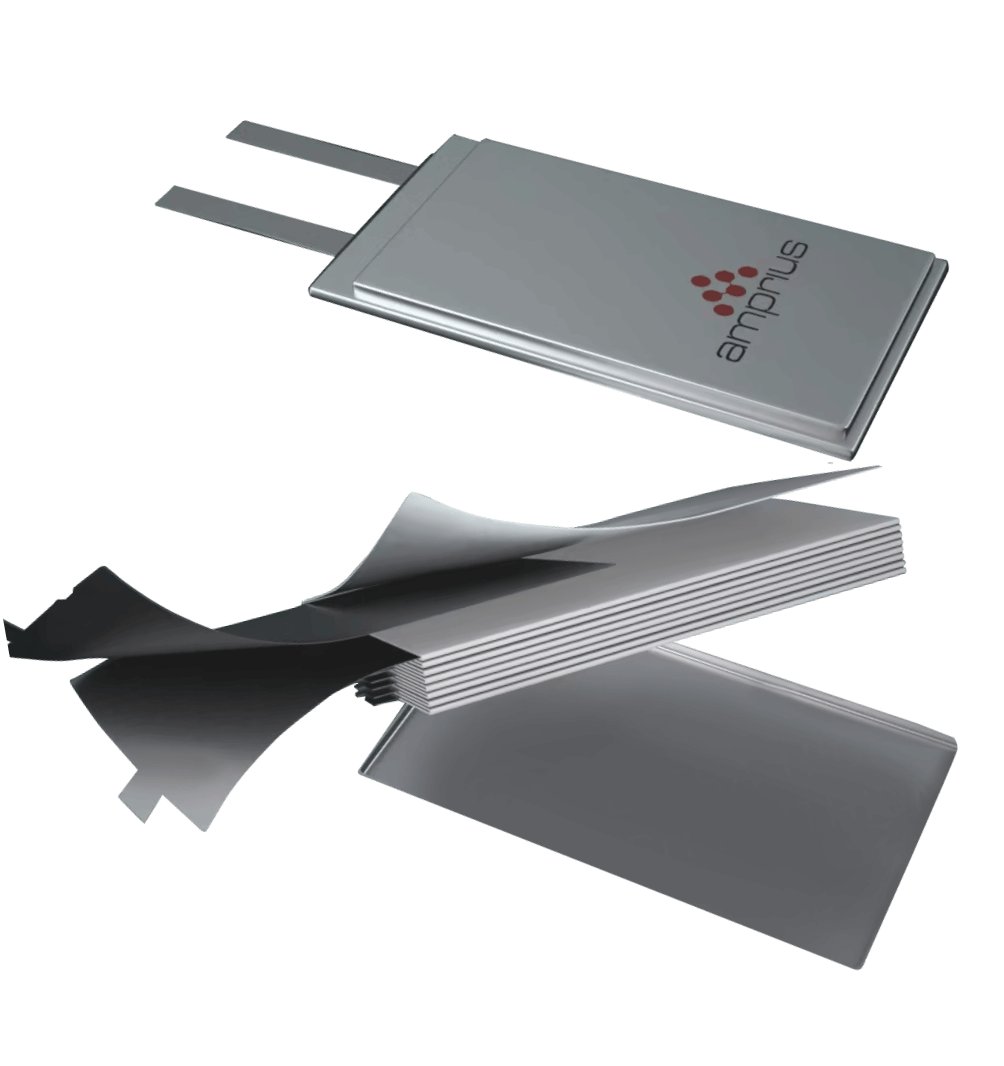 Amprius Technologies SiCore SA03 Pouch Cell
Battery cells are the individual lithium cells from which drone packs are built, usually cylindrical 18650 or 21700 cells or pouch cells. Their ratings determine how much energy and current a pack built from them can deliver.
Form factor
For batteries the finished pack, for cells the format such as 18650, 21700 or pouch. Cylindrical cells are mechanically robust and standardised; pouch cells are lighter but sensitive to pressure.
C-rate
Continuous discharge current as a multiple of capacity: continuous current divided by capacity in Ah. For cells the value is usually calculated from continuous current and capacity; promotional peak C-ratings on labels are not continuous values.
Continuous current (A)
Current the battery or cell can deliver continuously without overheating. It must exceed the total current of all motors in hover, with a margin for manoeuvres.
Energy (Wh)
Stored energy in watt-hours, nominal voltage times capacity. It is the best figure for comparing flight time and determines the rules for shipping and air travel.
Weight (g)
Weight of the pack or cell. It feeds directly into energy density and is often the largest single item in a drone's take-off mass.
Capacity (mAh)
Charge in milliampere-hours. On its own it says little about flight time, because what matters is energy (Wh) relative to weight.
Nominal voltage (V)
Average voltage during discharge according to the manufacturer. Together with capacity it determines the energy (Wh).
Cell count (S)
Always 1S for single cells. In a pack several cells are connected in series; this is done by the pack manufacturer.
Connector
Single cells usually have no connector; the connection is only made in the pack by spot-welding the cell interconnects.
Energy density (Wh/kg)
Energy per kilogram, decisive for long flight times. For Tattu and Herewin packs, the figure in the product name is higher than the recalculated value (probably the cell value); use the recalculated value for comparisons.
Cell chemistry
Chemical system of the cells, such as LiPo, LiPo HV, semi-solid LiPo, Li-ion or lithium metal. LiPo delivers high currents, while Li-ion and semi-solid cells store more energy per kilogram with lower current capability.
For long-range drones, high energy density and capacity matter; for heavy or fast drones, high continuous current. In the data, 21700 cylindrical cells offer more capacity per cell than 18650. Silicon-anode cells reach higher energy densities, often with lower current capability. For many cells the C-rate is calculated from continuous current and capacity; the cell maker's datasheet is authoritative. Assembling packs belongs in specialist workshops with suitable test and protection equipment.
For transport, lithium batteries must meet the tests of the UN Manual of Tests and Criteria, Part III, subsection 38.3 (UN 38.3) (IATA passenger leaflet, revision 3, February 2019).
Protect spare batteries against short circuits, for example in the original packaging or with taped terminals (IATA leaflet). Airlines may impose stricter rules; check the current version before travelling.
Molicel datasheets are only available from the manufacturer via a contact form; the data come from public copies.
What do 18650 and 21700 mean?
The numbers describe the cylindrical cell format: the first two digits the diameter, the following ones the length in millimetres.
Why is the C-rate of cells often calculated?
Many cell makers state the continuous current in amperes; the C-rate follows by dividing it by the capacity.
Which cell suits long flight times?
Cells with a high energy density in Wh/kg, provided their continuous current covers the pack's hover current.