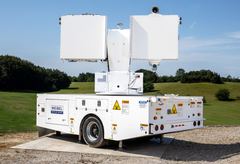
Radars for drone detection
Manufacturers in this group:
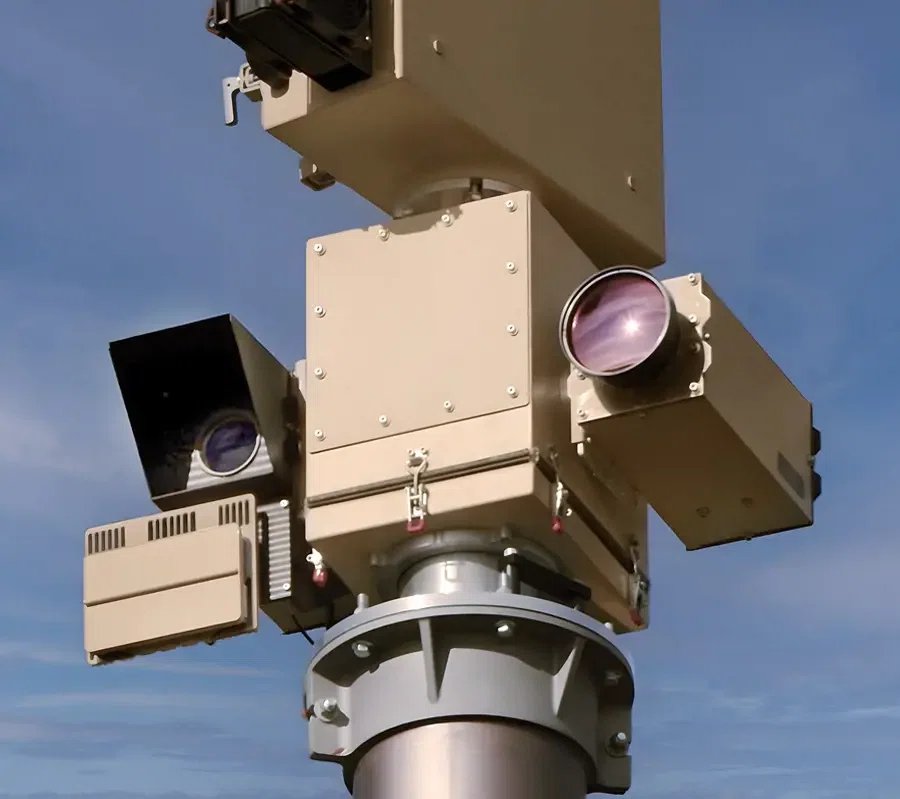 Echodyne EchoGuard
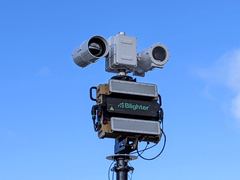
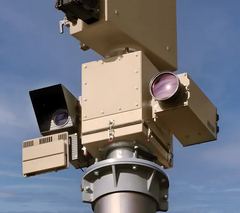
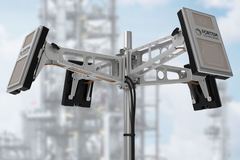
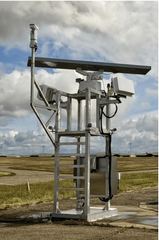
Drone radars emit radio waves and detect drones by the reflected echo, even when the drones do not transmit. Modern units distinguish drones from birds by movement patterns and micro-Doppler signatures.
Coverage (degrees)
Horizontal detection or effect angle of a single unit. All-round protection needs either a 360-degree unit or several sector units.
Field of use
Fields of use named by the manufacturer, such as airport, prison, critical infrastructure, event, police or military. This is a manufacturer statement, not a permission to operate.
Detection range (km)
Distance up to which the radar detects a drone according to the manufacturer. It depends strongly on the radar cross-section (RCS): small plastic drones are detected later, so always check the manufacturer's reference value.
Radar band
Frequency band of the radar, such as K, Ku or X band. Higher bands allow compact antennas and fine resolution but are attenuated more by rain.
Weight (kg)
Weight of the device or main unit in kilograms. For stationary installations usually without mast, power supply and control station.
Maximum targets
Number of targets the system can track simultaneously. Important for swarms or heavy nearby air traffic, for example at airports.
Mobility
Design: handheld, portable, vehicle-mounted, relocatable or stationary. It determines whether the system suits fixed sites or changing locations.
Sensor type
Type of detection or effect, such as radar, passive RF detector, camera or jammer. Combining several sensor types reduces false alarms and gaps.
Principle of effect
Describes in general terms how the system acts on a drone, for example radio jamming, protocol takeover or a capture net. For sensor-only systems it is empty or only describes detection.
Effect range (km)
Distance up to which the countermeasure works according to the manufacturer. Not given for sensor-only systems; manufacturer figures apply to favourable conditions.
Approval note
Short note from the data on approval and authorisation to operate, such as “authorities only” or “export licence required”. It does not replace a legal assessment of the individual case.
Detection range depends strongly on the drone's radar cross-section, so always read manufacturer figures together with the stated reference value. All-round surveillance needs a rotating or electronically scanned 360-degree radar or several sector units. Higher frequency bands allow compact, light units but are attenuated more by rain. The maximum number of targets matters at airports and with swarms. Radar complements RF detectors and cameras, which help with classification and identification.
Radars transmit too: in Germany every use of frequencies requires an assignment by the Bundesnetzagentur (§ 91(1) TKG). The corresponding rules for Poland were not checked.
Ranges are manufacturer figures under favourable conditions and only partly comparable between manufacturers. No prices are available. Radar figures depend strongly on the radar cross-section (RCS).
Does radar detect drones that do not transmit?
Yes, radar detects the reflected echo regardless of the drone's radio link.
Why is the range shorter for small drones?
Small plastic drones reflect little radar energy; their echo only stands out from the background at shorter distances.
How does a radar distinguish drones from birds?
By flight path, speed and the micro-Doppler signature of spinning propellers, often supported by classification software.